

Syria Analysis: Four-day truce announced on January 20 after major government offensive diminishes Kurdish control in northeastern Syria; avoid all travel
Executive Summary:
- The Syrian government launched a broad offensive on January 16-18, taking over vast swathes of territory controlled by the Kurdish AANES in northeastern Syria. This was likely influenced by stalled integration talks, Turkish support for a campaign, and reduced prospects of US backlash.
- The government and AANES reached a ceasefire and integration deal on January 18, reflecting a significant shift of momentum in favor of the government.
- The tenets nullified Kurdish autonomy, which likely prompted the SDF to stall its finalization, resulting in the breakdown on January 19.
- Despite the agreement of a four-day truce, its temporary nature and the high risk of spoiler attacks render the eruption of hostilities high in the coming days. Flashpoints will be Kobani, Qamishli, and al-Hasakah.
- Should this materialize, it will increase the risk of sectarian tensions and associated protests in Syria and adjacent countries with a sizeable Kurdish population, including Iraq and Turkey.
Current Situation:
January 18 ceasefire agreement:
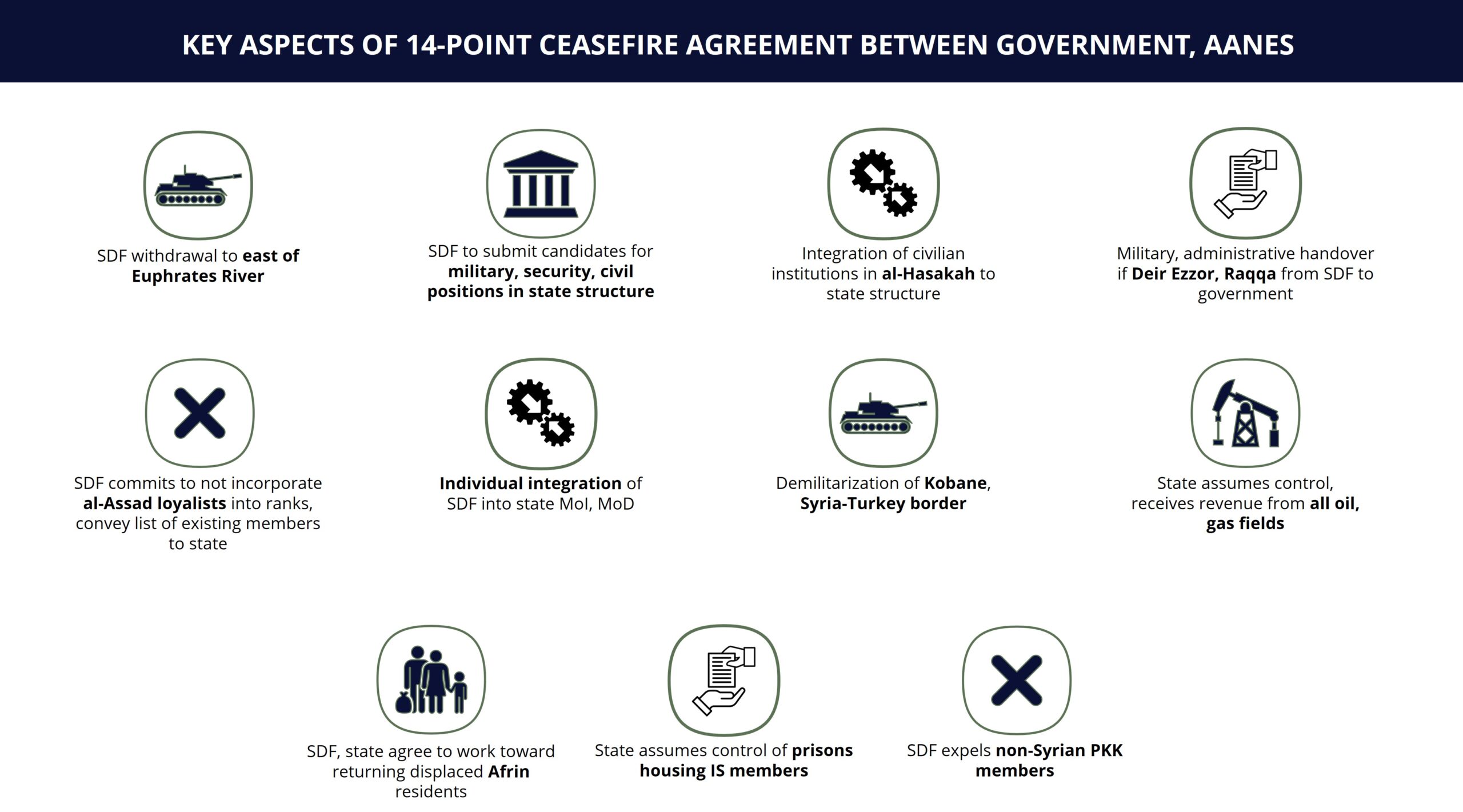
- During the evening hours (local time) of January 18, Syrian President Ahmad al-Sharaa announced that his government and the Autonomous Administration of North and East Syria (AANES) reached a 14-point ceasefire.
- Syrian Democratic Forces (SDF) commander Mazloum Abdi confirmed the agreement in a televised address. He stated that the latest armed conflict, which was “planned by many sides,” was imposed on the SDF. Abdi stated that the SDF would insist on “protecting the gains of the revolution.”
Collapse of the ceasefire agreement on January 19:
- On January 19, President al-Sharaa and SDF commander Abdi met in Damascus to discuss and formally sign the ceasefire agreement. Reports indicate that the negotiations collapsed following several hours of discussion.
- The SDF subsequently called for a full mobilization of Kurdish people across Syria, the MENA region, and Europe.
Developments on January 20:
- The Syrian Ministry of Interior (MoI) stated that about 120 Islamic State (IS) members escaped al-Hasakah province’s Shaddadi Prison. Syrian Arab Army (SAA) troops entered the city and carried out arrest operations, resulting in the recapture of 81 escapees. The MoI also claimed that SDF troops had withdrawn from al-Hasakah’s al-Hol camp without coordinating with Damascus or the US-led anti-IS coalition.
- The SDF stated that troops had withdrawn to predominantly Kurdish areas which it vowed to defend.
- The Syrian Ministry of Defense (MoD) affirmed Damascus’s readiness to take control of all IS detention facilities in the region. It called on the SDF to implement the January 18 agreement and stressed that government forces would not enter Kurdish villages and towns.
- The Ministry of Defense announced that it will implement a four-day ceasefire in all regions where the SAA operates, starting from 20:00 (local time) on January 20.
- According to Syria’s state news agency, Damascus and the SDF had reached a “common understanding” on a number of issues related to the future of al-Hasakah province.
Protests in Kurdish-populated regions outside Syria:
- On January 20, clashes between Kurdish protesters and Turkish security forces were recorded at Turkey’s Nusaybin Border crossing on the Syrian border adjacent to Kobani. Footage depicts hundreds of demonstrators marching to the border.
- On January 20, the US Consulate in Erbil advised US citizens to avoid travel to the vicinity of large protests due to the risk of violence. This followed several protests in northern Iraq’s Kurdistan Regional Government’s (KRG) capital, including in front of the US Consulate.
Assessments & Forecast:
Stalled negotiations for integration catalyzed broad government offensive
- On March 10, 2025, the Syrian government and the AANES signed an agreement stipulating the integration of the AANES’ civil and military institutions, including the US-backed SDF, into the President Ahmad al-Sharaa-led administration’s institutions and the new SAA by the end of 2025. The deadline expired, with the parties failing to reach a mutually acceptable agreement on the integration in talks on January 4. This likely triggered an eruption of clashes on January 6 between the SAA and AANES Internal Security Forces (Asayish) in Aleppo city’s Kurdish-dominated Sheikh Maqsoud and Ashrafiyeh neighborhoods. The SAA subsequently declared the areas closed military zones and, after heavy clashes, the government assumed control of these locales on January 10.
- Despite a proclaimed ceasefire, Damascus accused the SDF of launching over ten drones at Aleppo city and cutting off the water supply on January 10-11, while armed conflict surged along the frontlines between government-held and SDF-held territory in eastern Aleppo province. The continued hostilities, against the backdrop of stalled integration talks, likely prompted the government to expedite operational plans for a broader campaign to acquire territorial control across northeastern Syria, a longstanding objective for the new government.
Factors influencing government decision-making on new offensive
- Firstly, President al-Sharaa’s decision-making was likely informed by the rapid success of the SAA in taking over Aleppo city’s Ashrafieh and Sheikh Maqsoud. The SDF’s inability to defend the enclaves for a sustained period likely convinced Damascus that a major military operation into SDF-controlled territory west of the Euphrates had a high prospect of success. He likely also assessed that a quick offensive and significant territorial gains would prove more effective in reaching an accord on the government’s terms rather than conceding to the SDF at the negotiation table.
- International actors with vested interests in the Syrian arena likely also influenced President al-Sharaa’s decision-making. It is highly likely that Turkey, the strongest backer of the new Syrian government, encouraged President al-Sharaa to launch the latest offensive. This is because Ankara has viewed the SDF’s control of territory along the Turkey-Syria border region as a significant threat to Turkey’s national security. In this context, Ankara carried out several large-scale incursions into northern Syria to expel the SDF, which it views as the Syrian branch of the Kurdistan Workers’ Party (PKK), from the border region in recent years. Turkish officials have repeatedly warned that the SDF must integrate or face military action.
- An SAA offensive and territorial takeover in northeastern Syria would therefore align with Turkish interests. This is lent further credence by the contents of the January 18 ceasefire, several points of which align with Turkey’s national security objectives. This includes a commitment from the SDF to expel non-Syrian PKK fighters and the demilitarization of Kobani, which sits on the Turkish border. These measures would aim to reverse Syria’s perceived status as a safe haven for a major adversary to the Turkish state in recent years and reduce the immediate threat along Turkey’s border.
- The US likely also played an influential role in President al-Sharaa’s calculus to launch the offensive. Washington has remained a major backer of the SDF, which has been a crucial partner in the US-led anti-IS coalition in Syria in recent years. This likely acted as a restraining factor dissuading the Syrian government from launching military action against the SDF in the past. However, the US has significantly increased its engagement with the new government in recent months, primarily focusing on counter-IS collaboration, which culminated in the admission of Syria to the US-led anti-IS coalition and the lifting of Caesar Sanctions in November and December 2025, respectively.
- In this context, President al-Sharaa’s government likely assessed that the prospects for a US intervention or a souring of the relationship as a result of the offensive to be low overall. This is particularly given Washington’s preference for a strong Syrian government controlling the entire country, rather than encouraging federal structures in regions populated by minority groups, which President Trump likely views as a likely source of instability that could be exploited by IS.
- Overall, these factors created a window of opportunity for the SAA to launch a rapid offensive to fulfil President al-Sharaa’s longstanding aim of monopolizing territorial control, aligning with the interests of its Turkish ally, without risking a deterioration of its new relationship with Washington.
Role of Arab tribes in expediting collapse of AANES forces’ territorial hold
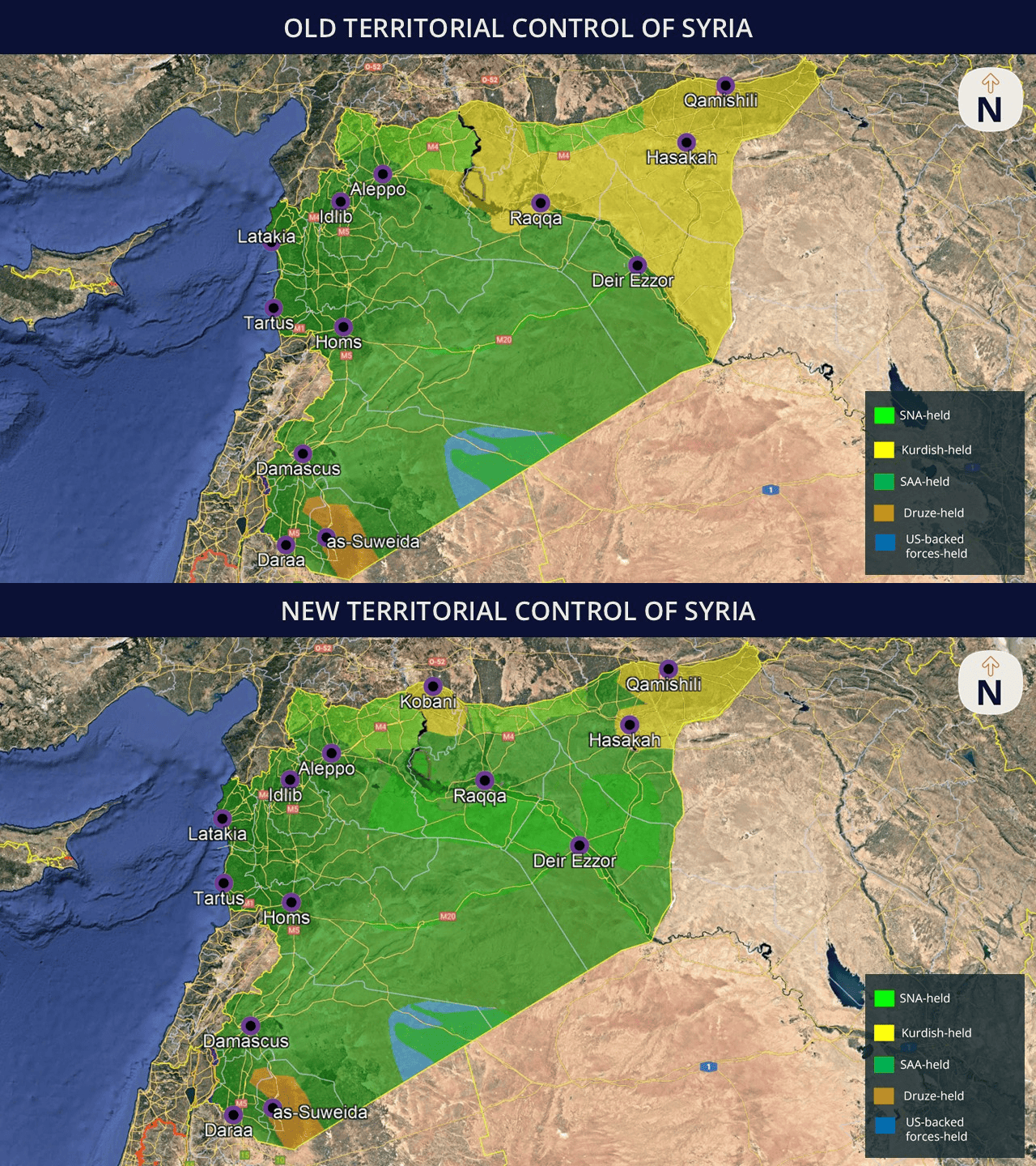
- A critical factor in the speed of the government takeover, which will also likely help consolidate the government’s gains, is the role of Arab tribes in northeastern Syria. Damascus likely assessed that Arab tribes in SDF-controlled territory, which had aligned themselves with the Kurdish-dominated operations room to fight IS in recent years, would swiftly defect to the Syrian Islamist government in the event of a broad offensive. This was likely based on the fact that some Arab tribes, such as those in the Deir Ezzor Military Council, declared their allegiance to Ahmad al-Sharaa’s Hayat Tahrir al-Sham (HTS)-led rebel fighters as early as December 2024.
- It is also rooted in long-standing tensions in Arab-majority areas in AANES-controlled regions of eastern Syria. Arab tribes’ perceived marginalization by the Kurdish-dominated administration has led to periodic waves of civil disobedience against the AANES in recent years, with crackdowns by SDF troops fomenting ethnic tensions.
- Against this backdrop, Damascus has pursued an active outreach to Arab tribes in eastern Syria in recent months, as shown by a meeting between President al-Sharaa and the Chief of the Shammar tribe, a major SDF-aligned group in al-Hasakah province. The fact that Arab tribes reportedly joined the government’s anti-SDF offensive, with the Shammar tribe officially declaring its defection on January 17, underscores that Damascus’ calculus was accurate in this context, constituting an important part of the operation’s success.
Collapse of ceasefire likely catalyzed by SDF reluctance to agree to significant concessions
- The January 18 ceasefire and integration agreement between the Syrian government and the AANES marked a significant, albeit short-lived, milestone. The AANES’ acceptance of the agreement was likely a result of the government’s swift territorial advances. The fact that government forces achieved near-total control of Deir Ezzor and Raqqa provinces, also capturing key infrastructure such as the Euphrates Dam, oil and gas fields, marked a broad collapse of the SDF’s leverage. This likely forced the AANES to initially consent to the 14-point ceasefire and integration agreement in a bid to halt the armed conflict.
- In this context, the draft agreement constituted a significant achievement for President al-Sharaa’s administration, institutionalizing major territorial gains of resource-rich provinces and strategic infrastructure. It also effectively nullified Kurdish autonomy for several reasons. Firstly, revenue from oil sales constituted a key pillar of the AANES’ income, facilitating its capacity to maintain a functioning governance structure. The takeover by government forces will reverse this.
- Importantly, the draft agreement’s stipulation that SDF fighters integrate into the Syrian government’s security apparatus on an individual basis, rather than as divisions, would have effectively terminated the SDF’s capacity to maintain command and control over distinct units within the centralized security apparatus. It would have also diminished the Kurdish-dominated operation room’s capacity to maintain a level of autonomy, even in al-Hasakah province, where the AANES was not explicitly required to cede military control to Damascus, as per the agreement.
- This likely constituted a particular point of contention for the AANES and its support base, as indicated by SDF Commander Abdi’s January 18 televised address, in which he pledged to preserve the “gains of the revolution.” This is especially given that Damascus had allegedly signaled its readiness to accept the absorption of SDF troops into three distinct SAA divisions prior to the eruption of hostilities in recent weeks, which would have preserved some autonomy.
- In this vein, Abdi likely pushed to secure concessions from President al-Sharaa or delay the implementation of the ceasefire provisions in the January 19 meeting in Damascus, which was meant to formalize the agreement. However, President al-Sharaa’s swift rejection of SDF demands underscores the superior negotiating position of the government following its significant territorial gains, and the significantly weakened status of the AANES. This likely triggered the breakdown of talks and simultaneously influenced the new four-day truce.
Factors influencing four-day truce
- The quick establishment of a new four-day truce was likely shaped by several factors. Firstly, it reflects the AANES’ significantly weakened position and inability to withstand a new SAA offensive, which would likely lead to its complete dissolution. This probably prompted the SDF to agree to a pause in hostilities.
- The unspecified understandings in al-Hasakah were likely key to securing its acceptance. However, these are more likely to constitute a symbolic offering of limited authority for the AANES and its forces, rather than signaling major concessions granted by Damascus. This is based on the significant leverage and momentum gained by the government following its successes in recent days compared to the considerable AANES losses.
- The US and Turkey likely also played a significant role in reaching the truce. For Ankara, a new pause in hostilities would facilitate the stabilization of the Syria-Turkey border region and likely still lead to a similar ceasefire akin to that agreed on January 18 which aligns with Turkey’s national security objectives. For Washington, the pause in fighting will not only suspend hostilities between its two partners in the country, but it will also enable the securing of major prisons housing IS militants in the region.
- This is particularly important in light of the reported prison breaks over the past day, and the high likelihood of further incidents happening in the absence of a truce. This is because both IS and potentially jihadist elements within the government’s security apparatus could attempt to capitalize upon the volatile security environment to facilitate a jail break that would replenish the group’s ranks.
Risk of armed conflict remains extreme in northeastern Syria despite truce
- Despite the truce, and as indicated by the breakdown of the January 18 ceasefire, the risk of armed hostilities erupting along friction points in northeastern Syria will remain significant. This is given the temporary nature of the agreement and the significant concessions the SDF will likely have to make to reach a permanent settlement in light of the government’s strengthened position.
- The prospects of a breakdown will also be raised by the high risk of spoiler attacks by more radical factions within the AANES umbrella, including the People’s Defense Units (YPG) and PKK who are likely to view any deal as capitulation, in addition to extremists within the government forces. Flashpoints for hostilities will be frontlines near Kobani, Qamishli, and al-Hasakah.
- Should this materialize, it would compound the elevated risk of sectarian tensions and associated protests/unrest in Syria. Reports of maltreatment by government forces in Kurdish areas would increase this likelihood, particularly amid heightened sensitivities and concerns regarding government forces’ conduct during previous bouts of sectarian violence with Alawite and Druze communities. Despite the government’s effort to reassure the Kurdish population, including through the January 16 decrees and its most recent statement on January 20, more radical Kurdish factions will likely fuel these narratives as part of efforts to undermine Damascus and mobilize support.
- This will also sustain the risk of pro-Kurdish protests materializing in adjacent countries with significant Kurdish populations, including Iraq and Turkey. The US Consulate of Erbil’s advisory and reports of protests in the city on January 20, in addition to reported unrest in Turkey’s Nusaybin, located adjacent to Kobani, support this.
Recommendations:
Syria
- Avoid all travel to Syria at the current juncture due to the volatile security environment, including the elevated risks of militancy and armed conflict.
- Those operating in northeastern Syria over the coming days are advised to shelter in place given the volatile security situation and the significant risk of armed conflict between government troops and SDF fighters. Keep abreast of updates and comply with measures announced by local authorities.
- Travel to Damascus should be for essential purposes only, while adhering to all security precautions regarding the threat of militant attacks and potential for airstrikes.
- Those conducting essential operations should seek security escorts and a local fixer to facilitate coordination with Syrian government authorities.
- Avoid the vicinity of government and military installations throughout Syria, including in Damascus, as well as the border areas with Israel and Lebanon due to the persistent risk of Israeli strikes.
- Use only vetted and secure private transportation from a hotel, company, or organization.
- Remain cognizant of the elevated risk of sectarian violence in the country, particularly in and around as-Suweida, Latakia, and Tartus provinces, and Kurdish-dominated northeastern parts of the country. Avoid discussing sectarian issues in public due to heightened sensitivities.
- Remain cognizant of the extreme risk posed by jihadist militant groups in the country, including the Islamic State (IS).
Turkey & Iraq
- Those operating in Kurdish-populated regions in southeastern Turkey and northern Iraq’s Kurdistan Regional Government (KRG) are advised to avoid the vicinity of pro-Kurdish demonstrations due to the associated risk of civil unrest.
- In Turkey, demonstrations are also likely to occur in cities with a substantial Kurdish community outside the southeast, including Istanbul and Izmir.
Executive Summary:
- The Syrian government launched a broad offensive on January 16-18, taking over vast swathes of territory controlled by the Kurdish AANES in northeastern Syria. This was likely influenced by stalled integration talks, Turkish support for a campaign, and reduced prospects of US backlash.
- The government and AANES reached a ceasefire and integration deal on January 18, reflecting a significant shift of momentum in favor of the government.
- The tenets nullified Kurdish autonomy, which likely prompted the SDF to stall its finalization, resulting in the breakdown on January 19.
- Despite the agreement of a four-day truce, its temporary nature and the high risk of spoiler attacks render the eruption of hostilities high in the coming days. Flashpoints will be Kobani, Qamishli, and al-Hasakah.
- Should this materialize, it will increase the risk of sectarian tensions and associated protests in Syria and adjacent countries with a sizeable Kurdish population, including Iraq and Turkey.
Current Situation:
January 18 ceasefire agreement:
- During the evening hours (local time) of January 18, Syrian President Ahmad al-Sharaa announced that his government and the Autonomous Administration of North and East Syria (AANES) reached a 14-point ceasefire.
- Syrian Democratic Forces (SDF) commander Mazloum Abdi confirmed the agreement in a televised address. He stated that the latest armed conflict, which was “planned by many sides,” was imposed on the SDF. Abdi stated that the SDF would insist on “protecting the gains of the revolution.”
Collapse of the ceasefire agreement on January 19:
- On January 19, President al-Sharaa and SDF commander Abdi met in Damascus to discuss and formally sign the ceasefire agreement. Reports indicate that the negotiations collapsed following several hours of discussion.
- The SDF subsequently called for a full mobilization of Kurdish people across Syria, the MENA region, and Europe.
Developments on January 20:
- The Syrian Ministry of Interior (MoI) stated that about 120 Islamic State (IS) members escaped al-Hasakah province’s Shaddadi Prison. Syrian Arab Army (SAA) troops entered the city and carried out arrest operations, resulting in the recapture of 81 escapees. The MoI also claimed that SDF troops had withdrawn from al-Hasakah’s al-Hol camp without coordinating with Damascus or the US-led anti-IS coalition.
- The SDF stated that troops had withdrawn to predominantly Kurdish areas which it vowed to defend.
- The Syrian Ministry of Defense (MoD) affirmed Damascus’s readiness to take control of all IS detention facilities in the region. It called on the SDF to implement the January 18 agreement and stressed that government forces would not enter Kurdish villages and towns.
- The Ministry of Defense announced that it will implement a four-day ceasefire in all regions where the SAA operates, starting from 20:00 (local time) on January 20.
- According to Syria’s state news agency, Damascus and the SDF had reached a “common understanding” on a number of issues related to the future of al-Hasakah province.
Protests in Kurdish-populated regions outside Syria:
- On January 20, clashes between Kurdish protesters and Turkish security forces were recorded at Turkey’s Nusaybin Border crossing on the Syrian border adjacent to Kobani. Footage depicts hundreds of demonstrators marching to the border.
- On January 20, the US Consulate in Erbil advised US citizens to avoid travel to the vicinity of large protests due to the risk of violence. This followed several protests in northern Iraq’s Kurdistan Regional Government’s (KRG) capital, including in front of the US Consulate.
Assessments & Forecast:
Stalled negotiations for integration catalyzed broad government offensive
- On March 10, 2025, the Syrian government and the AANES signed an agreement stipulating the integration of the AANES’ civil and military institutions, including the US-backed SDF, into the President Ahmad al-Sharaa-led administration’s institutions and the new SAA by the end of 2025. The deadline expired, with the parties failing to reach a mutually acceptable agreement on the integration in talks on January 4. This likely triggered an eruption of clashes on January 6 between the SAA and AANES Internal Security Forces (Asayish) in Aleppo city’s Kurdish-dominated Sheikh Maqsoud and Ashrafiyeh neighborhoods. The SAA subsequently declared the areas closed military zones and, after heavy clashes, the government assumed control of these locales on January 10.
- Despite a proclaimed ceasefire, Damascus accused the SDF of launching over ten drones at Aleppo city and cutting off the water supply on January 10-11, while armed conflict surged along the frontlines between government-held and SDF-held territory in eastern Aleppo province. The continued hostilities, against the backdrop of stalled integration talks, likely prompted the government to expedite operational plans for a broader campaign to acquire territorial control across northeastern Syria, a longstanding objective for the new government.
Factors influencing government decision-making on new offensive
- Firstly, President al-Sharaa’s decision-making was likely informed by the rapid success of the SAA in taking over Aleppo city’s Ashrafieh and Sheikh Maqsoud. The SDF’s inability to defend the enclaves for a sustained period likely convinced Damascus that a major military operation into SDF-controlled territory west of the Euphrates had a high prospect of success. He likely also assessed that a quick offensive and significant territorial gains would prove more effective in reaching an accord on the government’s terms rather than conceding to the SDF at the negotiation table.
- International actors with vested interests in the Syrian arena likely also influenced President al-Sharaa’s decision-making. It is highly likely that Turkey, the strongest backer of the new Syrian government, encouraged President al-Sharaa to launch the latest offensive. This is because Ankara has viewed the SDF’s control of territory along the Turkey-Syria border region as a significant threat to Turkey’s national security. In this context, Ankara carried out several large-scale incursions into northern Syria to expel the SDF, which it views as the Syrian branch of the Kurdistan Workers’ Party (PKK), from the border region in recent years. Turkish officials have repeatedly warned that the SDF must integrate or face military action.
- An SAA offensive and territorial takeover in northeastern Syria would therefore align with Turkish interests. This is lent further credence by the contents of the January 18 ceasefire, several points of which align with Turkey’s national security objectives. This includes a commitment from the SDF to expel non-Syrian PKK fighters and the demilitarization of Kobani, which sits on the Turkish border. These measures would aim to reverse Syria’s perceived status as a safe haven for a major adversary to the Turkish state in recent years and reduce the immediate threat along Turkey’s border.
- The US likely also played an influential role in President al-Sharaa’s calculus to launch the offensive. Washington has remained a major backer of the SDF, which has been a crucial partner in the US-led anti-IS coalition in Syria in recent years. This likely acted as a restraining factor dissuading the Syrian government from launching military action against the SDF in the past. However, the US has significantly increased its engagement with the new government in recent months, primarily focusing on counter-IS collaboration, which culminated in the admission of Syria to the US-led anti-IS coalition and the lifting of Caesar Sanctions in November and December 2025, respectively.
- In this context, President al-Sharaa’s government likely assessed that the prospects for a US intervention or a souring of the relationship as a result of the offensive to be low overall. This is particularly given Washington’s preference for a strong Syrian government controlling the entire country, rather than encouraging federal structures in regions populated by minority groups, which President Trump likely views as a likely source of instability that could be exploited by IS.
- Overall, these factors created a window of opportunity for the SAA to launch a rapid offensive to fulfil President al-Sharaa’s longstanding aim of monopolizing territorial control, aligning with the interests of its Turkish ally, without risking a deterioration of its new relationship with Washington.
Role of Arab tribes in expediting collapse of AANES forces’ territorial hold
- A critical factor in the speed of the government takeover, which will also likely help consolidate the government’s gains, is the role of Arab tribes in northeastern Syria. Damascus likely assessed that Arab tribes in SDF-controlled territory, which had aligned themselves with the Kurdish-dominated operations room to fight IS in recent years, would swiftly defect to the Syrian Islamist government in the event of a broad offensive. This was likely based on the fact that some Arab tribes, such as those in the Deir Ezzor Military Council, declared their allegiance to Ahmad al-Sharaa’s Hayat Tahrir al-Sham (HTS)-led rebel fighters as early as December 2024.
- It is also rooted in long-standing tensions in Arab-majority areas in AANES-controlled regions of eastern Syria. Arab tribes’ perceived marginalization by the Kurdish-dominated administration has led to periodic waves of civil disobedience against the AANES in recent years, with crackdowns by SDF troops fomenting ethnic tensions.
- Against this backdrop, Damascus has pursued an active outreach to Arab tribes in eastern Syria in recent months, as shown by a meeting between President al-Sharaa and the Chief of the Shammar tribe, a major SDF-aligned group in al-Hasakah province. The fact that Arab tribes reportedly joined the government’s anti-SDF offensive, with the Shammar tribe officially declaring its defection on January 17, underscores that Damascus’ calculus was accurate in this context, constituting an important part of the operation’s success.
Collapse of ceasefire likely catalyzed by SDF reluctance to agree to significant concessions
- The January 18 ceasefire and integration agreement between the Syrian government and the AANES marked a significant, albeit short-lived, milestone. The AANES’ acceptance of the agreement was likely a result of the government’s swift territorial advances. The fact that government forces achieved near-total control of Deir Ezzor and Raqqa provinces, also capturing key infrastructure such as the Euphrates Dam, oil and gas fields, marked a broad collapse of the SDF’s leverage. This likely forced the AANES to initially consent to the 14-point ceasefire and integration agreement in a bid to halt the armed conflict.
- In this context, the draft agreement constituted a significant achievement for President al-Sharaa’s administration, institutionalizing major territorial gains of resource-rich provinces and strategic infrastructure. It also effectively nullified Kurdish autonomy for several reasons. Firstly, revenue from oil sales constituted a key pillar of the AANES’ income, facilitating its capacity to maintain a functioning governance structure. The takeover by government forces will reverse this.
- Importantly, the draft agreement’s stipulation that SDF fighters integrate into the Syrian government’s security apparatus on an individual basis, rather than as divisions, would have effectively terminated the SDF’s capacity to maintain command and control over distinct units within the centralized security apparatus. It would have also diminished the Kurdish-dominated operation room’s capacity to maintain a level of autonomy, even in al-Hasakah province, where the AANES was not explicitly required to cede military control to Damascus, as per the agreement.
- This likely constituted a particular point of contention for the AANES and its support base, as indicated by SDF Commander Abdi’s January 18 televised address, in which he pledged to preserve the “gains of the revolution.” This is especially given that Damascus had allegedly signaled its readiness to accept the absorption of SDF troops into three distinct SAA divisions prior to the eruption of hostilities in recent weeks, which would have preserved some autonomy.
- In this vein, Abdi likely pushed to secure concessions from President al-Sharaa or delay the implementation of the ceasefire provisions in the January 19 meeting in Damascus, which was meant to formalize the agreement. However, President al-Sharaa’s swift rejection of SDF demands underscores the superior negotiating position of the government following its significant territorial gains, and the significantly weakened status of the AANES. This likely triggered the breakdown of talks and simultaneously influenced the new four-day truce.
Factors influencing four-day truce
- The quick establishment of a new four-day truce was likely shaped by several factors. Firstly, it reflects the AANES’ significantly weakened position and inability to withstand a new SAA offensive, which would likely lead to its complete dissolution. This probably prompted the SDF to agree to a pause in hostilities.
- The unspecified understandings in al-Hasakah were likely key to securing its acceptance. However, these are more likely to constitute a symbolic offering of limited authority for the AANES and its forces, rather than signaling major concessions granted by Damascus. This is based on the significant leverage and momentum gained by the government following its successes in recent days compared to the considerable AANES losses.
- The US and Turkey likely also played a significant role in reaching the truce. For Ankara, a new pause in hostilities would facilitate the stabilization of the Syria-Turkey border region and likely still lead to a similar ceasefire akin to that agreed on January 18 which aligns with Turkey’s national security objectives. For Washington, the pause in fighting will not only suspend hostilities between its two partners in the country, but it will also enable the securing of major prisons housing IS militants in the region.
- This is particularly important in light of the reported prison breaks over the past day, and the high likelihood of further incidents happening in the absence of a truce. This is because both IS and potentially jihadist elements within the government’s security apparatus could attempt to capitalize upon the volatile security environment to facilitate a jail break that would replenish the group’s ranks.
Risk of armed conflict remains extreme in northeastern Syria despite truce
- Despite the truce, and as indicated by the breakdown of the January 18 ceasefire, the risk of armed hostilities erupting along friction points in northeastern Syria will remain significant. This is given the temporary nature of the agreement and the significant concessions the SDF will likely have to make to reach a permanent settlement in light of the government’s strengthened position.
- The prospects of a breakdown will also be raised by the high risk of spoiler attacks by more radical factions within the AANES umbrella, including the People’s Defense Units (YPG) and PKK who are likely to view any deal as capitulation, in addition to extremists within the government forces. Flashpoints for hostilities will be frontlines near Kobani, Qamishli, and al-Hasakah.
- Should this materialize, it would compound the elevated risk of sectarian tensions and associated protests/unrest in Syria. Reports of maltreatment by government forces in Kurdish areas would increase this likelihood, particularly amid heightened sensitivities and concerns regarding government forces’ conduct during previous bouts of sectarian violence with Alawite and Druze communities. Despite the government’s effort to reassure the Kurdish population, including through the January 16 decrees and its most recent statement on January 20, more radical Kurdish factions will likely fuel these narratives as part of efforts to undermine Damascus and mobilize support.
- This will also sustain the risk of pro-Kurdish protests materializing in adjacent countries with significant Kurdish populations, including Iraq and Turkey. The US Consulate of Erbil’s advisory and reports of protests in the city on January 20, in addition to reported unrest in Turkey’s Nusaybin, located adjacent to Kobani, support this.
Recommendations:
Syria
- Avoid all travel to Syria at the current juncture due to the volatile security environment, including the elevated risks of militancy and armed conflict.
- Those operating in northeastern Syria over the coming days are advised to shelter in place given the volatile security situation and the significant risk of armed conflict between government troops and SDF fighters. Keep abreast of updates and comply with measures announced by local authorities.
- Travel to Damascus should be for essential purposes only, while adhering to all security precautions regarding the threat of militant attacks and potential for airstrikes.
- Those conducting essential operations should seek security escorts and a local fixer to facilitate coordination with Syrian government authorities.
- Avoid the vicinity of government and military installations throughout Syria, including in Damascus, as well as the border areas with Israel and Lebanon due to the persistent risk of Israeli strikes.
- Use only vetted and secure private transportation from a hotel, company, or organization.
- Remain cognizant of the elevated risk of sectarian violence in the country, particularly in and around as-Suweida, Latakia, and Tartus provinces, and Kurdish-dominated northeastern parts of the country. Avoid discussing sectarian issues in public due to heightened sensitivities.
- Remain cognizant of the extreme risk posed by jihadist militant groups in the country, including the Islamic State (IS).
Turkey & Iraq
- Those operating in Kurdish-populated regions in southeastern Turkey and northern Iraq’s Kurdistan Regional Government (KRG) are advised to avoid the vicinity of pro-Kurdish demonstrations due to the associated risk of civil unrest.
- In Turkey, demonstrations are also likely to occur in cities with a substantial Kurdish community outside the southeast, including Istanbul and Izmir.
Related Reports
-
 Supply Chain DisruptionsGlobal Special Report: Increasing sanctions encourage shadow fleet expansion, resulting in disruptions to maritime supply chain amid heightened scrutiny, militarization
 -
Supply Chain DisruptionsGlobal Special Report: Maritime shipping environment in Arctic to be fragile amid regulatory hurdles, militarization along Russian coastline, around Greenland
Related Reports
-
Supply Chain DisruptionsGlobal Special Report: Increasing sanctions encourage shadow fleet expansion, resulting in disruptions to maritime supply chain amid heightened scrutiny, militarization
-
Supply Chain DisruptionsGlobal Special Report: Maritime shipping environment in Arctic to be fragile amid regulatory hurdles, militarization along Russian coastline, around Greenland