

MENA Weekly Summary – December 31, 2025 – January 6, 2026
Highlights of the Week
This report reviews notable events in the Middle East and North Africa this week. These include fuel price hikes in Algeria, ongoing protests in Iran and the risk of renewed conflict with Israel, the prospects of a new Israeli campaign against Hezbollah in Lebanon, joint British-French airstrikes targeting the Islamic State in Syria, a counter-militancy operation in Tunisia’s Kasserine, and tensions between Saudi Arabia and the UAE in Yemen.
Algeria
Current Situation
- On January 1, Algeria reportedly implemented a fuel price hike for the first time in six years, raising prices between three and 33 percent across various oil derivatives, with the most significant increase applied to LPG.
- Between January 1-2, transportation workers staged a nationwide strike to protest the fuel price hikes and a draft traffic code proposing substantially higher penalties and fines for traffic violations. The strike was called off on January 2 following talks with government representatives.
Assessments & Forecast
Algeria is facing mounting fiscal pressure amid declining global oil prices and reduced hydrocarbon exports. Hydrocarbon exports reportedly fell by approximately nine percent between January and September 2025 compared with the same period in 2024. In addition, IMF estimates from 2023 indicated that prices for gasoline and diesel were more than 60 percent below cost-recovery levels, while natural gas and LPG prices were more than 90 percent below cost recovery. In this context, the authorities likely moved to reduce fuel subsidies and raise pump prices to ease pressure on public finances and reallocate resources toward more targeted social spending and development projects. This assessment is strengthened by the launch of recent social measures, including an increase in the minimum wage from 20,000 to 24,000 dinars and a planned rise in unemployment benefits from 15,000 to 18,000 dinars as of January 2026. These steps suggest an effort to provide short-term relief and mitigate cost-of-living pressures. The transportation strike and subsequent negotiations underscore the government’s sensitivity to social backlash, reinforcing the likelihood that the benefit increases were intended to offset the impact of subsidy reductions and support social stability. In the coming months, higher LPG prices are expected to increase household costs for cooking and heating, while higher fuel prices are likely to raise transportation costs, potentially contributing to upward inflationary pressures in the coming months.
Source: Asharq Business
Iran
Current Situation:
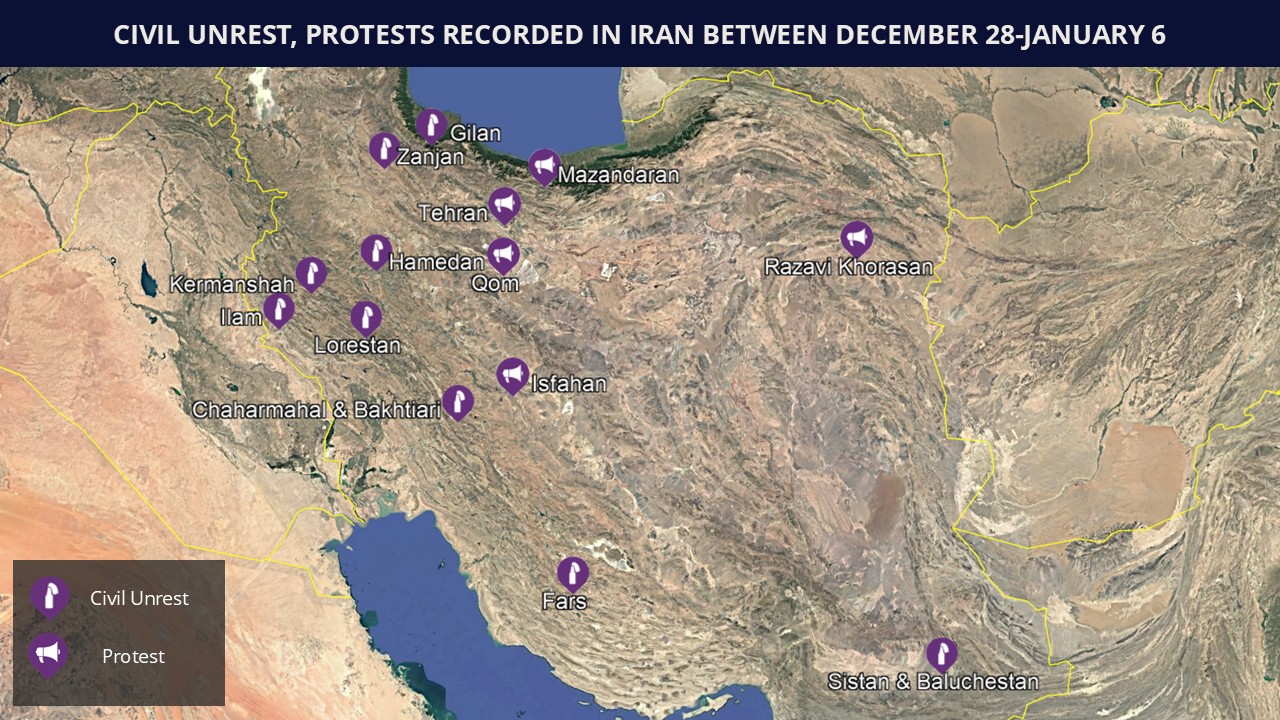
- On January 6, anti-government protests across Iran entered their tenth day.
- On January 2, US President Donald Trump threatened Iran that if it kills protestors, the US will come “to their rescue.”
- On the same day, Supreme National Security Council Secretary Ali Larijani warned that “US interference will destabilize the entire region and destroy American interests.” Foreign Minister Abbas Araghchi stated that Iran is “on standby and knows exactly where to aim in the event of any infringement of Iranian sovereignty.”
- On January 6, Iran warned that it would not wait for an act of aggression to respond if tangible indicators of threat emerged.
- Per January 6 reports, Israeli Prime Minister (PM) Benjamin Netanyahu conveyed messages to Tehran through Moscow that Jerusalem is not intending to attack it. Netanyahu simultaneously threatened Iran with “harsh consequences” if Tehran decided to attack Israel.
Assessments & Forecast: The ongoing protests are significant for their scale and persistence, reflecting deep public frustration over prolonged economic mismanagement and declining living standards. While the government has implemented an intense crackdown, it has simultaneously employed conciliatory rhetoric, offering limited concessions. This dual tone can be seen in Supreme Leader Ayatollah Ali Khamenei’s January 3 remarks acknowledging economic grievances while warning that “rioters” must be “put in their place,” indicating an effort to placate economically motivated protesters while justifying tougher measures for those engaged in unruly behavior. Nevertheless, continued unrest reflects the intense pressures facing the government, which have been amplified by President Trump’s threats combined with the US action against Venezuela’s president on January 3. Amid its weakened geopolitical stance following the 12-day war with Israel, all of the above has likely fueled Iran’s fears of potentially having to face American or Israeli attacks, leading it to bolster escalatory rhetoric and deterrence. Israel and the US still appear not to be logistically ready for a renewed military assault in Iran, lending some credence to Jerusalem’s calming messages regarding an imminent Israeli attack. Nevertheless, regional tensions will continue to be elevated, and both the US and Israel will attempt to encourage the protest movement in Iran.
Source: BBC; Donald Trump; Abbas Araghchi; Ali Lirjani; IRNA
Israel & Lebanon
Current Situation
- On December 31, 2025, the Israel Defense Forces (IDF) stated that Hezbollah had violated the ceasefire approximately 1,920 times in 2025.
- On January 3, Israel’s public broadcaster cited sources familiar with the matter stating that US President Donald Trump requested that Israel suspend the launch of a broader operation to allow for further talks with Beirut.
- On January 5, the IDF struck weapons depots and military infrastructures of Hezbollah and Hamas that were embedded in residential locales in several areas in Lebanon.
- On January 6, Lebanese President Joseph Aoun condemned Israeli strikes in southern Lebanon and the Bekaa region as undermining regional efforts for de-escalation ahead of a January 7 meeting of the ceasefire mechanism committee.
Assessments & Forecast: The latest strikes against Hezbollah operatives and infrastructure underscore Israel’s resolve to continue forcefully responding to Hezbollah’s reconstitution efforts. Washington’s reported request to delay a broader Israeli operation points to its current preference for diplomatic engagement to bridge gaps between Israel and Lebanon. However, the divergence between Beirut and Jerusalem’s assessments of Hezbollah’s military buildup remains extensive, eroding Israeli trust in Beirut’s disarmament success claims and reducing the viability of diplomacy as a means to constrain Hezbollah’s reconstitution. This is particularly considering Israel’s assessment that Hezbollah is engaged in the production of unmanned aerial vehicles (UAVs) and precision-guided missiles, which constitute part of its strategic arsenal. In this context, the outcome of the slated January 8 Lebanese Cabinet meeting on the implementation of the disarmament plan is highly unlikely to derail the current trajectory of escalation, even if Israel decides to delay its operational plans as part of coordination with the Trump administration.
Source: Israel Defense Forces
Syria
Current Situation
- On January 3, the British Ministry of Defense (MoD) confirmed that it had participated in a joint strike alongside French forces against an underground Islamic State (IS) weapons bunker, located north of Palmyra.
- Separately, on January 3, Syrian state media reported that three rockets were launched by unidentified perpetrators, landing near a communications building, the al-Muhammadi Mosque, and Mezzeh Military Airport in Damascus’s Mezzeh district.
Assessment & Forecast: The joint UK-France strike seemingly marks the first such action on IS targets following Syria’s accession to the International Coalition to Defeat IS in November 2025, rendering it notable. It follows a similar US-Jordanian strike in Palmyra on December 19, indicating that IS retains an entrenched presence and substantial arms stockpiles in the Palmyra area despite its diminished territorial control across Syria in recent years. The ability of the International Coalition to Defeat the IS to precisely target the access routes leading to the underground weapons bunker highlights the coalition’s high-level intelligence gathering and may further indicate that Syria’s accession to the coalition is yielding on-ground intelligence collection and coordination to initiate effective strikes. Conversely, the apparent rocket attack in Damascus’ Mezzeh district, which is the third incident in recent months, underscores critical gaps within Syria’s own domestic security apparatus. The authorities’ inability to identify the perpetrators of the repeated attacks likely reflects the overextension of the security apparatus as it contends with threats by multiple anti-government and extremist elements. While the government deepens international cooperation to degrade IS, multi-faceted security challenges will sustain volatility in the country.
Source: SANA
Tunisia
Current Situation
- Authorities announced on January 3 that they thwarted a terrorist attack in Kasserine’s Feriana, which resulted in the death of an Islamic State (IS)-affiliated militant near a weekly market.
- Authorities also reportedly arrested one of the militants’ accomplices, with security operations still ongoing. A member of the Tunisian security forces subsequently succumbed to his wounds sustained during the operation on January 4.
Assessments & Forecast: The latest operation in Feriana is notable given that the operation saw the deployment of lethal force in a seemingly public area, unlike the more frequent low-intensity counter-militancy operations involving the arrest of terrorist affiliates. For instance, in January 2025, authorities in Kasserine governorate detained a suspected militant for allegedly maintaining connections with militants abroad. While not explicitly confirmed, the decision to deploy lethal force in a public setting may have stemmed from an assessment that the terrorists were armed and that security forces faced a narrow window for interception, which heightened the threat to civilians during the operation. The operation reinforces Kasserine’s status as a area of persistent militant activity in Tunisia, where ongoing activity may be supported by transnational jihadist networks in neighboring Algeria, particularly in Tebessa governorate, which saw multiple militants killed during security operations in September and October 2025. Nevertheless, the successful disruption of a potential terrorist attack highlights the capacity of Tunisian intelligence to track and anticipate the movements of terrorist affiliates. The recent interception in Kasserine may have been supported by intelligence sharing between Tunisian and Algerian security forces from prior Algerian operations. With authorities stating that operations remain “ongoing” and considering the potential intelligence from the accomplice’s arrest, similar operations are likely in the coming days.
Source: Ministry of Interior
Yemen, Saudi Arabia & UAE
Current Situation
- On January 3, Saudi Arabia announced it would host a dialogue in Riyadh bringing together southern Yemeni factions to discuss “just solutions” to the southern issue.
- On January 7, Saudi-led coalition spokesperson Turki al-Maliki confirmed that a delegation of southern leaders departed for Riyadh, but stated that Southern Transitional Council (STC) President Aidarous al-Zubaidi failed to board the flight and instead fled to an undisclosed location.
- Al-Maliki further stated that al-Zubaidi had mobilized significant forces and armored vehicles from STC-affiliated camps in Aden’s Jabal Hadid toward al-Dhale.
- Later that morning (local time), the Saudi Air Force conducted preemptive airstrikes on the STC-held al-Zand camp in al-Dhale governorate.
- On January 7, the STC confirmed that al-Zubaidi is in Aden to “oversee military and security operations in the city,” and stated that a dialogue is necessary to address the southern issue.
Assessment & Forecast: Riyadh’s offer to host peace talks followed rapid advances by Saudi-backed forces, which regained control of Hadhramaut and al-Mahra, and appears aimed at consolidating these gains amid the STC’s military setbacks. Although the STC has endorsed the talks, al-Zubaidi’s decision not to travel to Riyadh may be perceived in Riyadh as a sign of defiance, likely intended to buy time to maximize remaining military leverage, particularly in al-Dhale, his stronghold, and in Aden, which currently remains under STC control. These developments increase tensions between the UAE and Saudi Arabia, though the STC’s continued engagement with the talks indicates that Abu Dhabi still lacks the appetite for direct confrontation with Riyadh. On the ground in Yemen, Saudi Arabia is likely to sustain military operations, as demonstrated by the airstrikes in al-Dhale to preempt STC momentum, while backing allied advances toward Aden. As such, the security situation in Aden is likely to remain highly volatile over the coming hours and days.
Sources: Turki al-Maliki ; STC
Other Developments
- Iran: Canada on January 3 updated its travel advisory, reiterating that Canadian citizens should continue to “avoid all travel” to Iran amid the ongoing large-scale demonstrations across the country.
- Israel: An individual from the Bedouin village of Tarabin al-Sana was shot dead on January 4 during a police operation to detain suspects accused of having torched vehicles in neighboring Jewish locales, reportedly in retaliation for police anti-crime operations targeting Bedouin communities.
- Israel & Palestinian Territories: According to reports from January 1, Israel has granted initial approval for the eventual construction of 126 housing units in the West Bank settlement of Sa-Nur.
- Lebanon & Syria: Unconfirmed reports indicate that on January 4, Lebanese authorities launched a campaign to identify leading figures of the former Syrian government, who fled to Lebanon after the takeover of the Ahmad al-Sharaa-led administration in Syria.
- Morocco: Marrakech’s Criminal Chamber of First Instance issued verdicts against 25 activists associated with the GenZ212 protest movement, per December 31 reports.
- Oman: Muscat approved the 2026 state budget on January 1, forecasting revenues of approximately 11.45 billion Omani Rial (OMR) and expenditures of 11.98 billion OMR. The resulting fiscal gap is projected at 530 million OMR (around 1.38 billion USD).
The Upcoming Week
- January 8: Tunisia’s Coffee Roasters Association, affiliated with the Tunisian Confederation of Citizen Enterprises (CONECT), has reportedly announced a demonstration and open-ended sit-in in front of the Ministry of Commerce in Tunis.
- January 10: The Tunisian Youth Movement Party has called for a protest from Tunis’ Belvedere Park to Habib Bourguiba Avenue from 15:00 (local time).
- January 10-14: The Oman Desert Marathon will be held in Bidiya, located about 230km away from the capital, Muscat.
- January 11: Morocco will commemorate the signing of the Manifesto of Independence in January 1944.
- January 12-14: Yennayer, the first month of the Berber Year, will be celebrated by the Amazigh ethnic community in Morocco.
- January 13: The “Families for Conscription” Forum has called for a protest rally in Israel’s capital, Jerusalem, from 16:30 (local time) to demand the draft of ultra-Orthodox community members and call on the government to pass a new conscription law. The group has not specified the event’s location.
- January 13: In Turkey, Ankara’s 26th Criminal Court of First Instance is slated to open a criminal trial over alleged irregularities at the Republican People’s Party’s (CHP) 38th Ordinary Congress.
Highlights of the Week
This report reviews notable events in the Middle East and North Africa this week. These include fuel price hikes in Algeria, ongoing protests in Iran and the risk of renewed conflict with Israel, the prospects of a new Israeli campaign against Hezbollah in Lebanon, joint British-French airstrikes targeting the Islamic State in Syria, a counter-militancy operation in Tunisia’s Kasserine, and tensions between Saudi Arabia and the UAE in Yemen.
Algeria
Current Situation
- On January 1, Algeria reportedly implemented a fuel price hike for the first time in six years, raising prices between three and 33 percent across various oil derivatives, with the most significant increase applied to LPG.
- Between January 1-2, transportation workers staged a nationwide strike to protest the fuel price hikes and a draft traffic code proposing substantially higher penalties and fines for traffic violations. The strike was called off on January 2 following talks with government representatives.
Assessments & Forecast
Algeria is facing mounting fiscal pressure amid declining global oil prices and reduced hydrocarbon exports. Hydrocarbon exports reportedly fell by approximately nine percent between January and September 2025 compared with the same period in 2024. In addition, IMF estimates from 2023 indicated that prices for gasoline and diesel were more than 60 percent below cost-recovery levels, while natural gas and LPG prices were more than 90 percent below cost recovery. In this context, the authorities likely moved to reduce fuel subsidies and raise pump prices to ease pressure on public finances and reallocate resources toward more targeted social spending and development projects. This assessment is strengthened by the launch of recent social measures, including an increase in the minimum wage from 20,000 to 24,000 dinars and a planned rise in unemployment benefits from 15,000 to 18,000 dinars as of January 2026. These steps suggest an effort to provide short-term relief and mitigate cost-of-living pressures. The transportation strike and subsequent negotiations underscore the government’s sensitivity to social backlash, reinforcing the likelihood that the benefit increases were intended to offset the impact of subsidy reductions and support social stability. In the coming months, higher LPG prices are expected to increase household costs for cooking and heating, while higher fuel prices are likely to raise transportation costs, potentially contributing to upward inflationary pressures in the coming months.
Source: Asharq Business
Iran
Current Situation:
- On January 6, anti-government protests across Iran entered their tenth day.
- On January 2, US President Donald Trump threatened Iran that if it kills protestors, the US will come “to their rescue.”
- On the same day, Supreme National Security Council Secretary Ali Larijani warned that “US interference will destabilize the entire region and destroy American interests.” Foreign Minister Abbas Araghchi stated that Iran is “on standby and knows exactly where to aim in the event of any infringement of Iranian sovereignty.”
- On January 6, Iran warned that it would not wait for an act of aggression to respond if tangible indicators of threat emerged.
- Per January 6 reports, Israeli Prime Minister (PM) Benjamin Netanyahu conveyed messages to Tehran through Moscow that Jerusalem is not intending to attack it. Netanyahu simultaneously threatened Iran with “harsh consequences” if Tehran decided to attack Israel.
Assessments & Forecast: The ongoing protests are significant for their scale and persistence, reflecting deep public frustration over prolonged economic mismanagement and declining living standards. While the government has implemented an intense crackdown, it has simultaneously employed conciliatory rhetoric, offering limited concessions. This dual tone can be seen in Supreme Leader Ayatollah Ali Khamenei’s January 3 remarks acknowledging economic grievances while warning that “rioters” must be “put in their place,” indicating an effort to placate economically motivated protesters while justifying tougher measures for those engaged in unruly behavior. Nevertheless, continued unrest reflects the intense pressures facing the government, which have been amplified by President Trump’s threats combined with the US action against Venezuela’s president on January 3. Amid its weakened geopolitical stance following the 12-day war with Israel, all of the above has likely fueled Iran’s fears of potentially having to face American or Israeli attacks, leading it to bolster escalatory rhetoric and deterrence. Israel and the US still appear not to be logistically ready for a renewed military assault in Iran, lending some credence to Jerusalem’s calming messages regarding an imminent Israeli attack. Nevertheless, regional tensions will continue to be elevated, and both the US and Israel will attempt to encourage the protest movement in Iran.
Source: BBC; Donald Trump; Abbas Araghchi; Ali Lirjani; IRNA
Israel & Lebanon
Current Situation
- On December 31, 2025, the Israel Defense Forces (IDF) stated that Hezbollah had violated the ceasefire approximately 1,920 times in 2025.
- On January 3, Israel’s public broadcaster cited sources familiar with the matter stating that US President Donald Trump requested that Israel suspend the launch of a broader operation to allow for further talks with Beirut.
- On January 5, the IDF struck weapons depots and military infrastructures of Hezbollah and Hamas that were embedded in residential locales in several areas in Lebanon.
- On January 6, Lebanese President Joseph Aoun condemned Israeli strikes in southern Lebanon and the Bekaa region as undermining regional efforts for de-escalation ahead of a January 7 meeting of the ceasefire mechanism committee.
Assessments & Forecast: The latest strikes against Hezbollah operatives and infrastructure underscore Israel’s resolve to continue forcefully responding to Hezbollah’s reconstitution efforts. Washington’s reported request to delay a broader Israeli operation points to its current preference for diplomatic engagement to bridge gaps between Israel and Lebanon. However, the divergence between Beirut and Jerusalem’s assessments of Hezbollah’s military buildup remains extensive, eroding Israeli trust in Beirut’s disarmament success claims and reducing the viability of diplomacy as a means to constrain Hezbollah’s reconstitution. This is particularly considering Israel’s assessment that Hezbollah is engaged in the production of unmanned aerial vehicles (UAVs) and precision-guided missiles, which constitute part of its strategic arsenal. In this context, the outcome of the slated January 8 Lebanese Cabinet meeting on the implementation of the disarmament plan is highly unlikely to derail the current trajectory of escalation, even if Israel decides to delay its operational plans as part of coordination with the Trump administration.
Source: Israel Defense Forces
Syria
Current Situation
- On January 3, the British Ministry of Defense (MoD) confirmed that it had participated in a joint strike alongside French forces against an underground Islamic State (IS) weapons bunker, located north of Palmyra.
- Separately, on January 3, Syrian state media reported that three rockets were launched by unidentified perpetrators, landing near a communications building, the al-Muhammadi Mosque, and Mezzeh Military Airport in Damascus’s Mezzeh district.
Assessment & Forecast: The joint UK-France strike seemingly marks the first such action on IS targets following Syria’s accession to the International Coalition to Defeat IS in November 2025, rendering it notable. It follows a similar US-Jordanian strike in Palmyra on December 19, indicating that IS retains an entrenched presence and substantial arms stockpiles in the Palmyra area despite its diminished territorial control across Syria in recent years. The ability of the International Coalition to Defeat the IS to precisely target the access routes leading to the underground weapons bunker highlights the coalition’s high-level intelligence gathering and may further indicate that Syria’s accession to the coalition is yielding on-ground intelligence collection and coordination to initiate effective strikes. Conversely, the apparent rocket attack in Damascus’ Mezzeh district, which is the third incident in recent months, underscores critical gaps within Syria’s own domestic security apparatus. The authorities’ inability to identify the perpetrators of the repeated attacks likely reflects the overextension of the security apparatus as it contends with threats by multiple anti-government and extremist elements. While the government deepens international cooperation to degrade IS, multi-faceted security challenges will sustain volatility in the country.
Source: SANA
Tunisia
Current Situation
- Authorities announced on January 3 that they thwarted a terrorist attack in Kasserine’s Feriana, which resulted in the death of an Islamic State (IS)-affiliated militant near a weekly market.
- Authorities also reportedly arrested one of the militants’ accomplices, with security operations still ongoing. A member of the Tunisian security forces subsequently succumbed to his wounds sustained during the operation on January 4.
Assessments & Forecast: The latest operation in Feriana is notable given that the operation saw the deployment of lethal force in a seemingly public area, unlike the more frequent low-intensity counter-militancy operations involving the arrest of terrorist affiliates. For instance, in January 2025, authorities in Kasserine governorate detained a suspected militant for allegedly maintaining connections with militants abroad. While not explicitly confirmed, the decision to deploy lethal force in a public setting may have stemmed from an assessment that the terrorists were armed and that security forces faced a narrow window for interception, which heightened the threat to civilians during the operation. The operation reinforces Kasserine’s status as a area of persistent militant activity in Tunisia, where ongoing activity may be supported by transnational jihadist networks in neighboring Algeria, particularly in Tebessa governorate, which saw multiple militants killed during security operations in September and October 2025. Nevertheless, the successful disruption of a potential terrorist attack highlights the capacity of Tunisian intelligence to track and anticipate the movements of terrorist affiliates. The recent interception in Kasserine may have been supported by intelligence sharing between Tunisian and Algerian security forces from prior Algerian operations. With authorities stating that operations remain “ongoing” and considering the potential intelligence from the accomplice’s arrest, similar operations are likely in the coming days.
Source: Ministry of Interior
Yemen, Saudi Arabia & UAE
Current Situation
- On January 3, Saudi Arabia announced it would host a dialogue in Riyadh bringing together southern Yemeni factions to discuss “just solutions” to the southern issue.
- On January 7, Saudi-led coalition spokesperson Turki al-Maliki confirmed that a delegation of southern leaders departed for Riyadh, but stated that Southern Transitional Council (STC) President Aidarous al-Zubaidi failed to board the flight and instead fled to an undisclosed location.
- Al-Maliki further stated that al-Zubaidi had mobilized significant forces and armored vehicles from STC-affiliated camps in Aden’s Jabal Hadid toward al-Dhale.
- Later that morning (local time), the Saudi Air Force conducted preemptive airstrikes on the STC-held al-Zand camp in al-Dhale governorate.
- On January 7, the STC confirmed that al-Zubaidi is in Aden to “oversee military and security operations in the city,” and stated that a dialogue is necessary to address the southern issue.
Assessment & Forecast: Riyadh’s offer to host peace talks followed rapid advances by Saudi-backed forces, which regained control of Hadhramaut and al-Mahra, and appears aimed at consolidating these gains amid the STC’s military setbacks. Although the STC has endorsed the talks, al-Zubaidi’s decision not to travel to Riyadh may be perceived in Riyadh as a sign of defiance, likely intended to buy time to maximize remaining military leverage, particularly in al-Dhale, his stronghold, and in Aden, which currently remains under STC control. These developments increase tensions between the UAE and Saudi Arabia, though the STC’s continued engagement with the talks indicates that Abu Dhabi still lacks the appetite for direct confrontation with Riyadh. On the ground in Yemen, Saudi Arabia is likely to sustain military operations, as demonstrated by the airstrikes in al-Dhale to preempt STC momentum, while backing allied advances toward Aden. As such, the security situation in Aden is likely to remain highly volatile over the coming hours and days.
Sources: Turki al-Maliki ; STC
Other Developments
- Iran: Canada on January 3 updated its travel advisory, reiterating that Canadian citizens should continue to “avoid all travel” to Iran amid the ongoing large-scale demonstrations across the country.
- Israel: An individual from the Bedouin village of Tarabin al-Sana was shot dead on January 4 during a police operation to detain suspects accused of having torched vehicles in neighboring Jewish locales, reportedly in retaliation for police anti-crime operations targeting Bedouin communities.
- Israel & Palestinian Territories: According to reports from January 1, Israel has granted initial approval for the eventual construction of 126 housing units in the West Bank settlement of Sa-Nur.
- Lebanon & Syria: Unconfirmed reports indicate that on January 4, Lebanese authorities launched a campaign to identify leading figures of the former Syrian government, who fled to Lebanon after the takeover of the Ahmad al-Sharaa-led administration in Syria.
- Morocco: Marrakech’s Criminal Chamber of First Instance issued verdicts against 25 activists associated with the GenZ212 protest movement, per December 31 reports.
- Oman: Muscat approved the 2026 state budget on January 1, forecasting revenues of approximately 11.45 billion Omani Rial (OMR) and expenditures of 11.98 billion OMR. The resulting fiscal gap is projected at 530 million OMR (around 1.38 billion USD).
The Upcoming Week
- January 8: Tunisia’s Coffee Roasters Association, affiliated with the Tunisian Confederation of Citizen Enterprises (CONECT), has reportedly announced a demonstration and open-ended sit-in in front of the Ministry of Commerce in Tunis.
- January 10: The Tunisian Youth Movement Party has called for a protest from Tunis’ Belvedere Park to Habib Bourguiba Avenue from 15:00 (local time).
- January 10-14: The Oman Desert Marathon will be held in Bidiya, located about 230km away from the capital, Muscat.
- January 11: Morocco will commemorate the signing of the Manifesto of Independence in January 1944.
- January 12-14: Yennayer, the first month of the Berber Year, will be celebrated by the Amazigh ethnic community in Morocco.
- January 13: The “Families for Conscription” Forum has called for a protest rally in Israel’s capital, Jerusalem, from 16:30 (local time) to demand the draft of ultra-Orthodox community members and call on the government to pass a new conscription law. The group has not specified the event’s location.
- January 13: In Turkey, Ankara’s 26th Criminal Court of First Instance is slated to open a criminal trial over alleged irregularities at the Republican People’s Party’s (CHP) 38th Ordinary Congress.
