

13
Jul 2026
12:58 UTC
Europe Analysis: High temperatures, droughts, wildfires expected across Europe in July-August, increasing operational, business risks
Executive Summary
- Further heatwaves are expected across Europe through July-August, with southern and southeastern Europe facing a higher risk of high temperatures and wildfires.
- Despite relatively lower absolute temperatures, northern and eastern Europe are also likely to experience disproportionate impacts due to lower heat adaptation.
- Prolonged heatwaves, droughts, and wildfires are likely to generate cascading disruptions across critical infrastructure and business operations, including transport, utilities, emergency services, and labor-intensive sectors, increasing operating costs and supply chain disruptions.
- Risk of climate activism and anti-tourism protests is also likely to remain elevated, with resource-intensive businesses, major infrastructure projects, and tourism-related facilities facing a higher risk of targeted protest activity.
- Travel and operations in Europe can continue, though organizations are advised to closely monitor official weather, wildfire, and civil protection advisories and review business continuity, travel, and emergency response plans for the coming weeks.
Current Situation
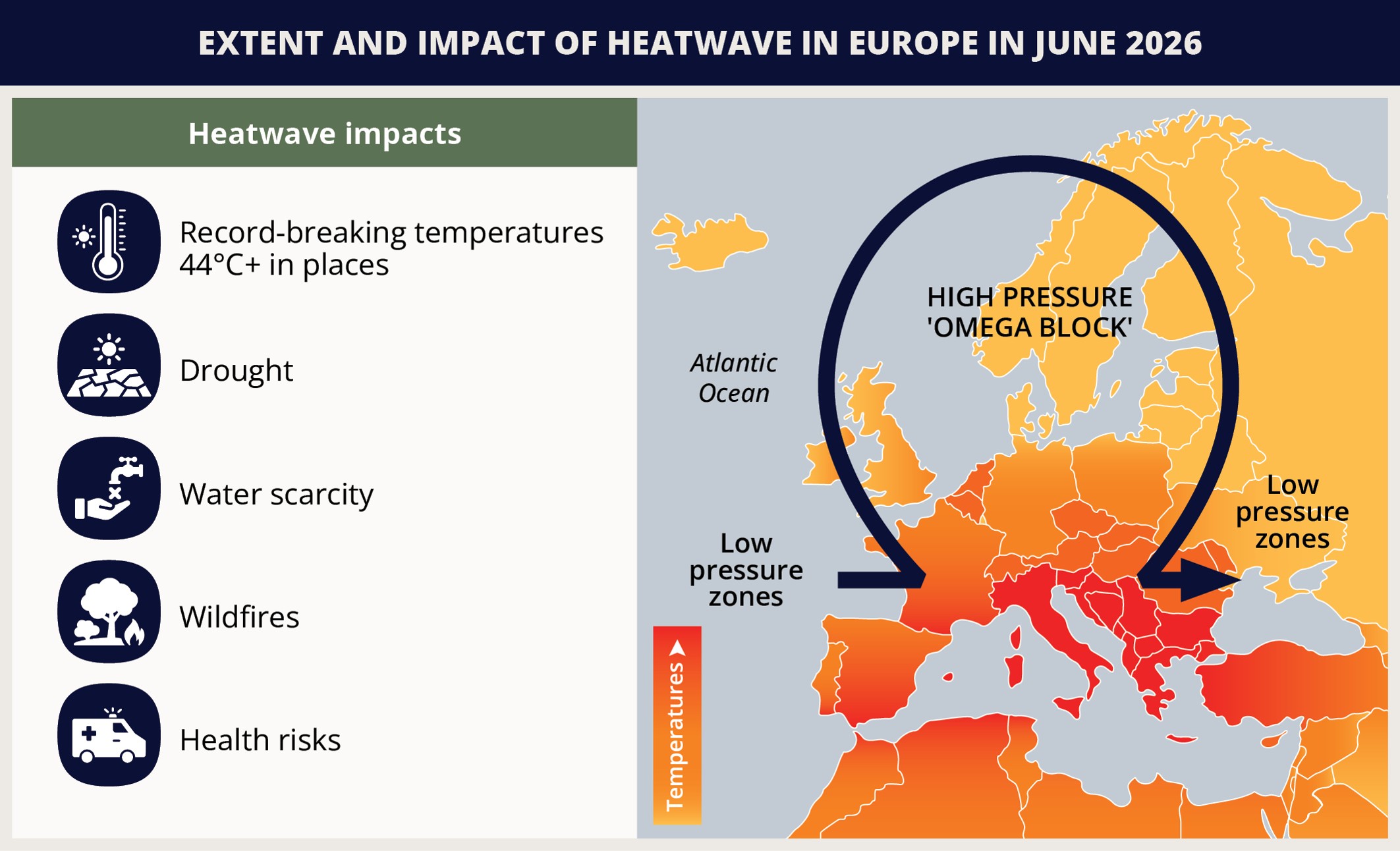
- Europe has experienced consecutive heatwaves since late May 2026, including a record-breaking late-May heatwave and a more severe heatwave between June 20–28, which has been reported to be the most severe recorded in Europe so far. Temperatures had reached 10–15 degrees Celsius above seasonal averages recorded during this period in the previous years, with some regions in France and Spain approaching 44 degrees Celsius.
- Czech Republic, Denmark, France, Germany, Poland, Slovakia, Spain, and Switzerland recorded their highest June temperatures on record. These countries joined Austria, Belgium, Hungary, Italy, the Netherlands, Romania, and the UK, which had already broken national June temperature records during the late-May heatwave.
- The extreme heat placed significant pressure on healthcare systems and emergency services, prompting governments to issue repeated heat-health warnings, activate emergency response measures, open cooling centers, and advise residents to avoid outdoor activities during peak daytime hours. As of early July, EuroMomo, a joint EU mortality surveillance system, reported around 10,000 deaths, of which over 9000 being people aged 65 and above, related to heatwaves across EU countries in June. These figures remain preliminary and are expected to increase as mortality data are updated.
- The heatwaves also placed significant pressure on electricity grids, as cooling demand surged. Belgium briefly recorded wholesale electricity prices exceeding EUR 1/kWh, while residential electricity consumption increased sharply in the Netherlands during the peak of the heatwave.
- Operational disruptions were widespread, with authorities implementing measures including school and hospital closures and restrictions on outdoor activities. Transport infrastructure was also affected, with approximately 140 flights cancelled and more than 3,400 delayed across western and central Europe on June 25–26, particularly at Barcelona El Prat Airport (BCN) and Amsterdam Schiphol Airport (AMS).
- Scientists attribute the severity of the heatwaves to a combination of long-term climate change and a persistent “omega block” weather pattern, in which a high-pressure system trapped exceptionally hot air from the Sahara between two low-pressure systems over western Europe for an extended period.
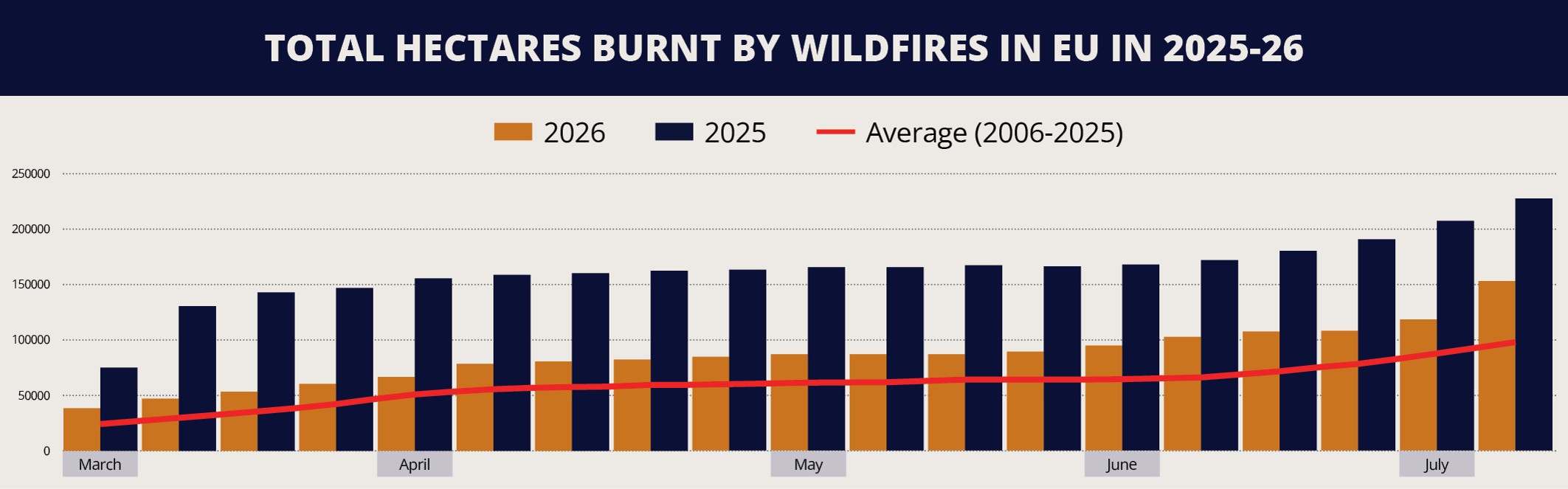
- Meanwhile, wildfires have also been reported, with the area affected by fires in the EU reaching 155, 569 hectares in 2026 as of early July. This is higher than the average recorded between 2006 and 2025 during the same period, which is 88, 440 hectares, but lower than the 2025 numbers, which are 208, 037, the worst year on record for wildfires in the bloc. As of July 13, active wildfires were burning simultaneously in France, Spain, Portugal, Greece, and the UK. At least 11 people have died due to an ongoing wildfire in Spain’s Andalusia as of July 10, which has been termed the country’s worst wildfire in more than two decades.
Assessments & Forecast
Heatwaves to persist through summer months, with southern and southeastern Europe facing the highest drought and wildfire risk
- FORECAST: Additional heatwaves are likely across Europe through July and August, with western and southern Europe expected to record the higher absolute temperatures. This is because of the persistent upper-level high-pressure system, also referred to as the “heat dome,” over western Europe, which is likely to continue blocking cooler Atlantic air, sustaining above-average temperatures and extending periods of extreme heat. Above-average sea surface temperatures in the Atlantic Ocean and Mediterranean Sea are also likely to limit overnight cooling, resulting in more frequent tropical nights and compounding heat stress on vulnerable populations and infrastructure.
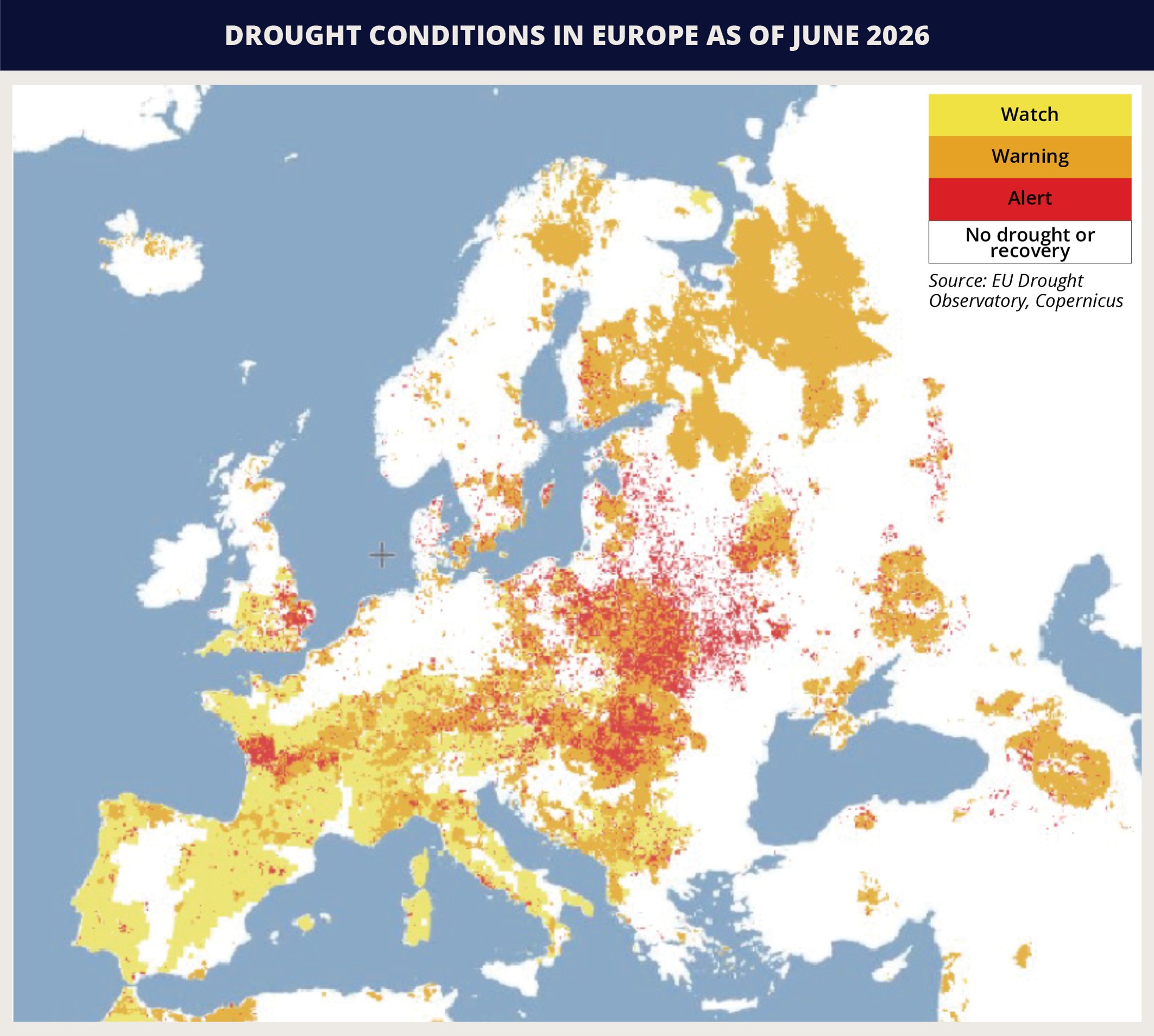
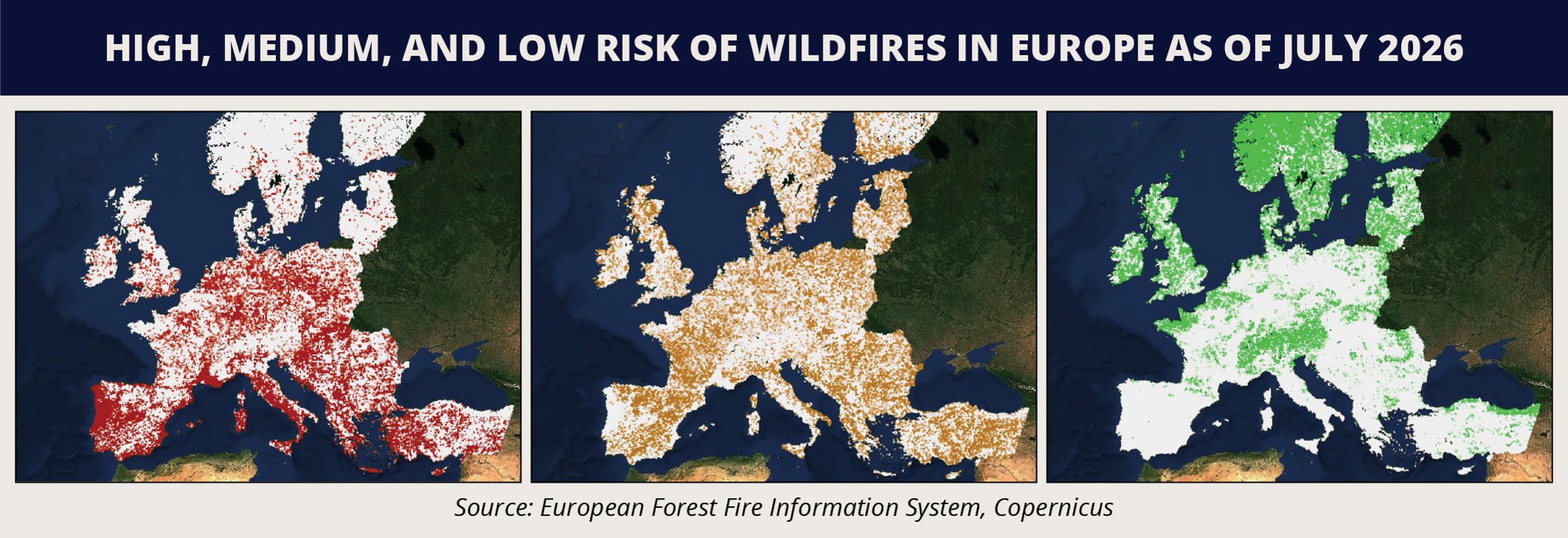
- FORECAST: As such, southern and southwestern Europe, including parts of Cyprus, France, Greece, Italy, Portugal, Spain, and parts of the Balkans, are likely to continue recording the highest absolute temperatures over the coming weeks due to their proximity to persistent hot air masses originating from North Africa. Meanwhile, although northern and eastern Europe, including northern Germany, Poland, the Benelux, the UK, the Baltic states, and parts of Scandinavia, will face less exposure to high temperatures, the impact of the heatwaves will still be elevated due to a lack of heat adaptability of infrastructure. Indeed, the buildings in these countries are generally less adapted to prolonged high temperatures, and air conditioning remains comparatively uncommon.
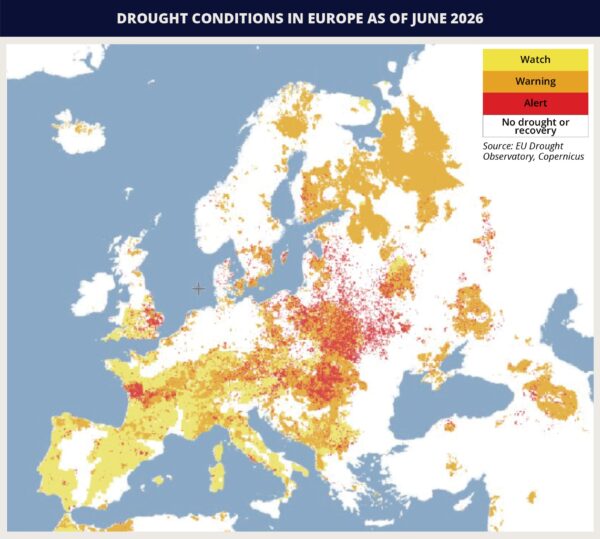
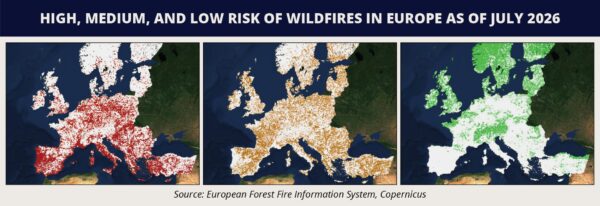
- FORECAST: Repeated heatwaves, combined with below-average spring precipitation and continued high evaporation rates, are likely to further intensify drought conditions and increase wildfire risk across Europe through the remainder of the summer. Southern and southeastern European countries, including Cyprus, France, Greece, Italy, Portugal, Spain, and parts of the Balkans, will continue to face the highest wildfire risk, consistent with the Mediterranean’s hot, dry summers and the persistence of above-average temperatures. Within these countries, heavily forested and already dry areas, such as northern Portugal, Spain’s Galicia, and Romania’s Hunedoara County, are likely to face the greatest risk of large wildfires. In contrast, areas with lower vegetation density or wetter local climates, including Spain’s Meseta Central and parts of the Alpine region, are likely to remain comparatively less exposed.
- FORECAST: Wildfire risk is likely to increase across parts of central-western and eastern Europe, including Austria, Germany, Hungary, Poland, Romania, and the UK, as repeated heatwaves further reduce soil moisture and dry vegetation. Although these countries are generally less prone to large wildfires than southern Europe, prolonged dry conditions and above-average temperatures are likely to increase both the frequency and scale of wildfire incidents in the coming weeks.
- FORECAST: Additional heatwaves are likely across Europe through July and August, with western and southern Europe expected to record the higher absolute temperatures. This is because of the persistent upper-level high-pressure system, also referred to as the “heat dome,” over western Europe, which is likely to continue blocking cooler Atlantic air, sustaining above-average temperatures and extending periods of extreme heat. Above-average sea surface temperatures in the Atlantic Ocean and Mediterranean Sea are also likely to limit overnight cooling, resulting in more frequent tropical nights and compounding heat stress on vulnerable populations and infrastructure.
- FORECAST: As such, southern and southwestern Europe, including parts of Cyprus, France, Greece, Italy, Portugal, Spain, and parts of the Balkans, are likely to continue recording the highest absolute temperatures over the coming weeks due to their proximity to persistent hot air masses originating from North Africa. Meanwhile, although northern and eastern Europe, including northern Germany, Poland, the Benelux, the UK, the Baltic states, and parts of Scandinavia, will face less exposure to high temperatures, the impact of the heatwaves will still be elevated due to a lack of heat adaptability of infrastructure. Indeed, the buildings in these countries are generally less adapted to prolonged high temperatures, and air conditioning remains comparatively uncommon.
- FORECAST: Repeated heatwaves, combined with below-average spring precipitation and continued high evaporation rates, are likely to further intensify drought conditions and increase wildfire risk across Europe through the remainder of the summer. Southern and southeastern European countries, including Cyprus, France, Greece, Italy, Portugal, Spain, and parts of the Balkans, will continue to face the highest wildfire risk, consistent with the Mediterranean’s hot, dry summers and the persistence of above-average temperatures. Within these countries, heavily forested and already dry areas, such as northern Portugal, Spain’s Galicia, and Romania’s Hunedoara County, are likely to face the greatest risk of large wildfires. In contrast, areas with lower vegetation density or wetter local climates, including Spain’s Meseta Central and parts of the Alpine region, are likely to remain comparatively less exposed.
- FORECAST: Wildfire risk is likely to increase across parts of central-western and eastern Europe, including Austria, Germany, Hungary, Poland, Romania, and the UK, as repeated heatwaves further reduce soil moisture and dry vegetation. Although these countries are generally less prone to large wildfires than southern Europe, prolonged dry conditions and above-average temperatures are likely to increase both the frequency and scale of wildfire incidents in the coming weeks.
Heatwaves, droughts, and wildfires to generate cascading operational disruptions across multiple sectors and businesses operations
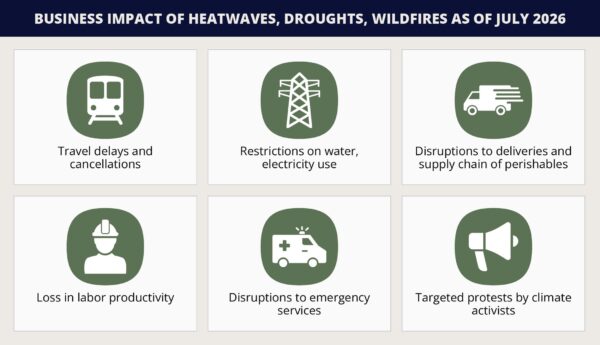
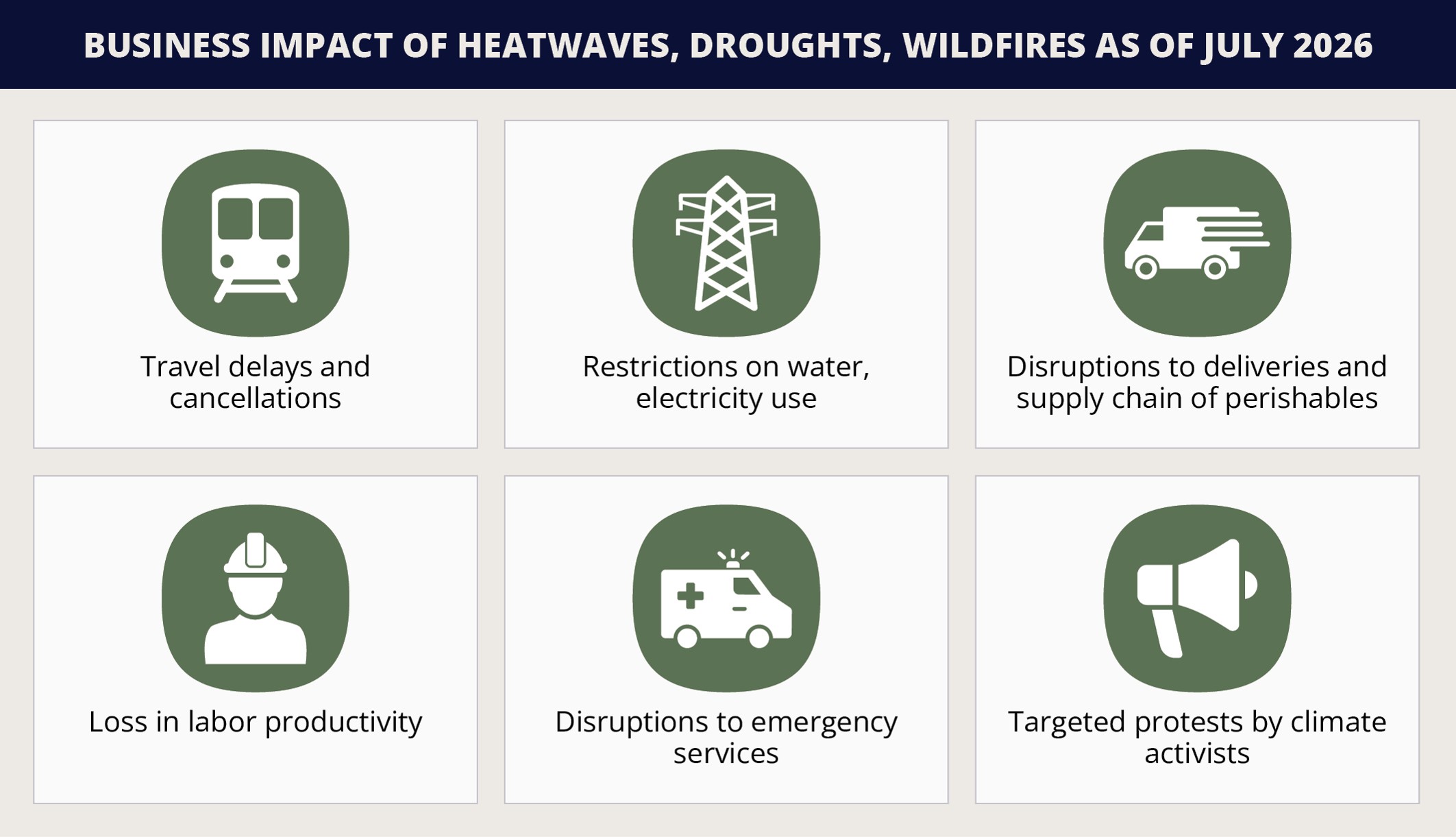
- FORECAST: Heatwaves and associated wildfires and droughts are likely to generate cascading disruptions across critical infrastructure, public services, and commercial operations throughout Europe during the summer period. Prolonged periods of extreme heat are expected to simultaneously strain electricity and water supplies, disrupt transport networks, reduce labor productivity, increase demand for emergency services, and increase operating costs for businesses. The most significant sectoral impacts are likely to include:
- Transportation infrastructure is likely to remain among the sectors most impacted by heatwaves and wildfires. As demonstrated during the May-June 2026 heatwaves, extreme temperatures can deform rail tracks, affect signaling systems and overhead power lines, increase the likelihood of equipment failures, and reduce aircraft take-off performance, resulting in speed restrictions, delays, and service cancellations. During the June 2026 heatwave, Belgium’s national rail operator (SNCB) cancelled approximately 100 trains per day over three consecutive days after extreme temperatures affected older rolling stock lacking air conditioning, while France’s SNCF cancelled around 70 Intercites services after withdrawing older trains vulnerable to heat-related air-conditioning failures. Wildfires are also likely to compound transport disruptions by forcing road closures, rail suspensions, airport restrictions due to smoke, reduced visibility, and precautionary closures of transport corridors in affected areas. Collectively, these disruptions are likely to generate cascading operational and economic impacts across logistics, tourism, aviation, manufacturing, retail, and energy sectors.
- Utilities and essential services are also likely to face significant disruption during prolonged heatwaves and droughts. Rising demand for cooling is expected to place sustained pressure on electricity grids, increasing the likelihood of localized power outages and equipment failures, particularly in areas with ageing electricity infrastructure or limited network redundancy. For example, approximately 68,000 households in France’s Brittany region lost power after a transformer failed during extreme temperatures on June 23-24, illustrating the vulnerability of electricity infrastructure during heatwaves. Prolonged heat and below-average rainfall are also expected to place increasing pressure on water resources, prompting authorities to impose conservation measures. During the 2025 heatwave and drought in Spain’s Andalusia, authorities implemented restrictions including bans on garden irrigation, limitations on car washing, and household water conservation measures. Together, increased demand for electricity and water, combined with supply constraints and operational disruptions, is likely to raise utility and operating costs for businesses across affected regions.
- Heatwaves and wildfires are also expected to overload emergency services. Heatwaves are likely to increase heat-related illnesses, dehydration, and cardiovascular emergencies, stretching hospitals, ambulance services, and emergency responders. During the late-June heatwave, authorities in Paris banned public alcohol consumption to reduce pressure on emergency services. Wildfires are also likely to stretch firefighting resources, particularly where multiple large fires occur simultaneously. During Spain’s severe 2025 wildfire season, authorities deployed almost 2,000 soldiers after existing firefighting units were unable to contain 20 concurrent major wildfires, illustrating the potential for prolonged heatwaves to overwhelm emergency response capacity.
- FORECAST: More broadly, business operations are also likely to be affected through reduced labor productivity and higher operating costs. Occupational health regulations are likely to require businesses to modify working hours, suspend outdoor work during periods of extreme heat, and implement additional worker protection measures. Wildfires may also force localized evacuations and temporary business closures, further disrupting operations. Agriculture is likely to remain among the sectors most affected owing to its dependence on water availability and outdoor labor. As of early July, agriculture remained subject to the most stringent water-use restrictions under drought alerts across much of France. Logistics operations are also likely to experience disruption, as demonstrated by delivery companies in the Netherlands implementing adjusted delivery schedules during the June heatwave to avoid peak afternoon temperatures and protect outdoor workers.
- FORECAST: Heatwaves and associated wildfires and droughts are likely to generate cascading disruptions across critical infrastructure, public services, and commercial operations throughout Europe during the summer period. Prolonged periods of extreme heat are expected to simultaneously strain electricity and water supplies, disrupt transport networks, reduce labor productivity, increase demand for emergency services, and increase operating costs for businesses. The most significant sectoral impacts are likely to include:
- Transportation infrastructure is likely to remain among the sectors most impacted by heatwaves and wildfires. As demonstrated during the May-June 2026 heatwaves, extreme temperatures can deform rail tracks, affect signaling systems and overhead power lines, increase the likelihood of equipment failures, and reduce aircraft take-off performance, resulting in speed restrictions, delays, and service cancellations. During the June 2026 heatwave, Belgium’s national rail operator (SNCB) cancelled approximately 100 trains per day over three consecutive days after extreme temperatures affected older rolling stock lacking air conditioning, while France’s SNCF cancelled around 70 Intercites services after withdrawing older trains vulnerable to heat-related air-conditioning failures. Wildfires are also likely to compound transport disruptions by forcing road closures, rail suspensions, airport restrictions due to smoke, reduced visibility, and precautionary closures of transport corridors in affected areas. Collectively, these disruptions are likely to generate cascading operational and economic impacts across logistics, tourism, aviation, manufacturing, retail, and energy sectors.
- Utilities and essential services are also likely to face significant disruption during prolonged heatwaves and droughts. Rising demand for cooling is expected to place sustained pressure on electricity grids, increasing the likelihood of localized power outages and equipment failures, particularly in areas with ageing electricity infrastructure or limited network redundancy. For example, approximately 68,000 households in France’s Brittany region lost power after a transformer failed during extreme temperatures on June 23-24, illustrating the vulnerability of electricity infrastructure during heatwaves. Prolonged heat and below-average rainfall are also expected to place increasing pressure on water resources, prompting authorities to impose conservation measures. During the 2025 heatwave and drought in Spain’s Andalusia, authorities implemented restrictions including bans on garden irrigation, limitations on car washing, and household water conservation measures. Together, increased demand for electricity and water, combined with supply constraints and operational disruptions, is likely to raise utility and operating costs for businesses across affected regions.
- Heatwaves and wildfires are also expected to overload emergency services. Heatwaves are likely to increase heat-related illnesses, dehydration, and cardiovascular emergencies, stretching hospitals, ambulance services, and emergency responders. During the late-June heatwave, authorities in Paris banned public alcohol consumption to reduce pressure on emergency services. Wildfires are also likely to stretch firefighting resources, particularly where multiple large fires occur simultaneously. During Spain’s severe 2025 wildfire season, authorities deployed almost 2,000 soldiers after existing firefighting units were unable to contain 20 concurrent major wildfires, illustrating the potential for prolonged heatwaves to overwhelm emergency response capacity.
- FORECAST: More broadly, business operations are also likely to be affected through reduced labor productivity and higher operating costs. Occupational health regulations are likely to require businesses to modify working hours, suspend outdoor work during periods of extreme heat, and implement additional worker protection measures. Wildfires may also force localized evacuations and temporary business closures, further disrupting operations. Agriculture is likely to remain among the sectors most affected owing to its dependence on water availability and outdoor labor. As of early July, agriculture remained subject to the most stringent water-use restrictions under drought alerts across much of France. Logistics operations are also likely to experience disruption, as demonstrated by delivery companies in the Netherlands implementing adjusted delivery schedules during the June heatwave to avoid peak afternoon temperatures and protect outdoor workers.
Risk of protest activity against alleged environmental harming and resource-intensive businesses to remain elevated
- FORECAST: In addition to operational disruptions, prolonged heatwaves, droughts, and wildfires are likely to intensify climate activism across western and southern Europe. Protest activity is expected to increasingly target governments, large infrastructure projects, and businesses perceived to contribute to environmental degradation or consume disproportionate amounts of water and energy during periods of resource scarcity. This risk has already been demonstrated by the environmental movement Soulevements de la Terre, which has carried out repeated protests against mega-irrigation basins since 2023 and organized a protest camp against the Seine-Nord Europe Canal in July 2026.
- FORECAST: Judging by the similar protest trends from 2023-2025 and online rhetoric among climate activist networks, businesses and projects associated with high water or energy consumption, especially in western and southern Europe, are likely to face an elevated risk of targeted protests in the coming months. This is because countries such as France, Germany, Greece, Italy, the Netherlands, Spain, and the UK, have an entrenched presence of left-wing and climate activist groups known to carry out targeted protests against perceived polluting entities. Targets include agriculture and irrigation projects, tourism and hospitality facilities, golf courses, data centers, large industrial facilities, mining operations, logistics hubs, and major infrastructure projects. The most likely tactics include demonstrations outside facilities, road blockades and site occupations, vandalism targeting property and equipment, sabotage of construction or irrigation infrastructure, and direct-action campaigns intended to delay or halt projects. Such actions will generally carry a moderate risk for disruptions to operations and violence, including occasional risk of violence in the form of clashes between protesters and the police. Activists are also likely to increase online campaigns, public naming-and-shaming of companies, and coordinate calls for boycotts targeting businesses perceived to contribute to environmental hazards.
- FORECAST: Additionally, anti-tourism protests are also likely to intensify during the peak summer season, particularly in southern Europe, including Croatia, Cyprus, Greece, Italy, Portugal, Spain, and southern France, which generally records high tourist footfall over the summer. Prolonged heatwaves and droughts are expected to reinforce perceptions that mass tourism exacerbates water shortages and strains local infrastructure. The large-scale anti-tourism protests in Spain during 2024–25 followed prolonged drought conditions, with residents in Barcelona arguing that tourism, particularly luxury tourism and high-end leisure facilities, was worsening local water scarcity. As tourist arrivals peak during July and August, similar protests are likely across major tourist destinations, such as southern France, Cyprus, and Spain, especially where water restrictions remain in place. Likely targets include hotels, resorts, cruise tourism, golf courses, and short-term rental properties, with demonstrations, port blockades, and vandalism remaining the most likely tactics.
- FORECAST: In addition to operational disruptions, prolonged heatwaves, droughts, and wildfires are likely to intensify climate activism across western and southern Europe. Protest activity is expected to increasingly target governments, large infrastructure projects, and businesses perceived to contribute to environmental degradation or consume disproportionate amounts of water and energy during periods of resource scarcity. This risk has already been demonstrated by the environmental movement Soulevements de la Terre, which has carried out repeated protests against mega-irrigation basins since 2023 and organized a protest camp against the Seine-Nord Europe Canal in July 2026.
- FORECAST: Judging by the similar protest trends from 2023-2025 and online rhetoric among climate activist networks, businesses and projects associated with high water or energy consumption, especially in western and southern Europe, are likely to face an elevated risk of targeted protests in the coming months. This is because countries such as France, Germany, Greece, Italy, the Netherlands, Spain, and the UK, have an entrenched presence of left-wing and climate activist groups known to carry out targeted protests against perceived polluting entities. Targets include agriculture and irrigation projects, tourism and hospitality facilities, golf courses, data centers, large industrial facilities, mining operations, logistics hubs, and major infrastructure projects. The most likely tactics include demonstrations outside facilities, road blockades and site occupations, vandalism targeting property and equipment, sabotage of construction or irrigation infrastructure, and direct-action campaigns intended to delay or halt projects. Such actions will generally carry a moderate risk for disruptions to operations and violence, including occasional risk of violence in the form of clashes between protesters and the police. Activists are also likely to increase online campaigns, public naming-and-shaming of companies, and coordinate calls for boycotts targeting businesses perceived to contribute to environmental hazards.
- FORECAST: Additionally, anti-tourism protests are also likely to intensify during the peak summer season, particularly in southern Europe, including Croatia, Cyprus, Greece, Italy, Portugal, Spain, and southern France, which generally records high tourist footfall over the summer. Prolonged heatwaves and droughts are expected to reinforce perceptions that mass tourism exacerbates water shortages and strains local infrastructure. The large-scale anti-tourism protests in Spain during 2024–25 followed prolonged drought conditions, with residents in Barcelona arguing that tourism, particularly luxury tourism and high-end leisure facilities, was worsening local water scarcity. As tourist arrivals peak during July and August, similar protests are likely across major tourist destinations, such as southern France, Cyprus, and Spain, especially where water restrictions remain in place. Likely targets include hotels, resorts, cruise tourism, golf courses, and short-term rental properties, with demonstrations, port blockades, and vandalism remaining the most likely tactics.
Recommendations
General
- Travel and operations in Europe can continue while closely monitoring official weather, wildfire, and civil protection advisories, and allow additional time for journeys due to potential transport disruptions, road closures, and flight or rail delays.
- Limit outdoor travel and strenuous activity during periods of extreme heat, particularly in the afternoon, and remain hydrated.
- Prioritize accommodations with reliable air conditioning where prolonged heatwaves are forecasted.
- Review travel itineraries in advance and identify alternative transport options where heatwaves or wildfires may disrupt travel.
- Follow evacuation orders immediately if wildfires threaten your area. Do not enter or drive through active wildfire zones.
- In general, travelers and operators in Europe are advised to monitor official weather agencies such as Meteoalarm, the European Forest Fire Information System (EFFIS), and the Copernicus Emergency Management Service (EMS) for Europewide weather-related updates, alerts, and guidelines.
Preventive and adaptive measures for business operations
- Monitor local heatwaves, wildfires, drought, as well as transport and health advisories, and establish thresholds for remote work, modified working hours, or temporary suspension of operations.
- Reschedule outdoor work to cooler morning or evening hours where feasible.
- Ensure employees have access to drinking water, shaded or air-conditioned rest areas, and regular breaks.
- Train supervisors to recognize heat-related illnesses and smoke exposure and establish procedures for medical emergencies.
- Develop contingency plans for power outages, transport disruptions, and wildfire evacuations, including alternative worksites and communication procedures.
- Review emergency plans for wildfire-prone facilities, including evacuation procedures, backup power, emergency supplies, and vegetation management.
- Reduce reliance on water-intensive processes where feasible and identify alternative water sources during droughts.
- Review travel policies to allow itinerary changes or postponement of non-essential travel during severe heatwaves.
- Organizations operating in sectors associated with high water or energy consumption, such as agriculture, tourism, manufacturing, mining, data centres, or large infrastructure projects, should also monitor activism and community opposition, as prolonged drought and water restrictions are likely to increase scrutiny and protest activity in affected areas.
Executive Summary
- Further heatwaves are expected across Europe through July-August, with southern and southeastern Europe facing a higher risk of high temperatures and wildfires.
- Despite relatively lower absolute temperatures, northern and eastern Europe are also likely to experience disproportionate impacts due to lower heat adaptation.
- Prolonged heatwaves, droughts, and wildfires are likely to generate cascading disruptions across critical infrastructure and business operations, including transport, utilities, emergency services, and labor-intensive sectors, increasing operating costs and supply chain disruptions.
- Risk of climate activism and anti-tourism protests is also likely to remain elevated, with resource-intensive businesses, major infrastructure projects, and tourism-related facilities facing a higher risk of targeted protest activity.
- Travel and operations in Europe can continue, though organizations are advised to closely monitor official weather, wildfire, and civil protection advisories and review business continuity, travel, and emergency response plans for the coming weeks.
Current Situation
- Europe has experienced consecutive heatwaves since late May 2026, including a record-breaking late-May heatwave and a more severe heatwave between June 20–28, which has been reported to be the most severe recorded in Europe so far. Temperatures had reached 10–15 degrees Celsius above seasonal averages recorded during this period in the previous years, with some regions in France and Spain approaching 44 degrees Celsius.
- Czech Republic, Denmark, France, Germany, Poland, Slovakia, Spain, and Switzerland recorded their highest June temperatures on record. These countries joined Austria, Belgium, Hungary, Italy, the Netherlands, Romania, and the UK, which had already broken national June temperature records during the late-May heatwave.
- The extreme heat placed significant pressure on healthcare systems and emergency services, prompting governments to issue repeated heat-health warnings, activate emergency response measures, open cooling centers, and advise residents to avoid outdoor activities during peak daytime hours. As of early July, EuroMomo, a joint EU mortality surveillance system, reported around 10,000 deaths, of which over 9000 being people aged 65 and above, related to heatwaves across EU countries in June. These figures remain preliminary and are expected to increase as mortality data are updated.
- The heatwaves also placed significant pressure on electricity grids, as cooling demand surged. Belgium briefly recorded wholesale electricity prices exceeding EUR 1/kWh, while residential electricity consumption increased sharply in the Netherlands during the peak of the heatwave.
- Operational disruptions were widespread, with authorities implementing measures including school and hospital closures and restrictions on outdoor activities. Transport infrastructure was also affected, with approximately 140 flights cancelled and more than 3,400 delayed across western and central Europe on June 25–26, particularly at Barcelona El Prat Airport (BCN) and Amsterdam Schiphol Airport (AMS).
- Scientists attribute the severity of the heatwaves to a combination of long-term climate change and a persistent “omega block” weather pattern, in which a high-pressure system trapped exceptionally hot air from the Sahara between two low-pressure systems over western Europe for an extended period.
- Meanwhile, wildfires have also been reported, with the area affected by fires in the EU reaching 155, 569 hectares in 2026 as of early July. This is higher than the average recorded between 2006 and 2025 during the same period, which is 88, 440 hectares, but lower than the 2025 numbers, which are 208, 037, the worst year on record for wildfires in the bloc. As of July 13, active wildfires were burning simultaneously in France, Spain, Portugal, Greece, and the UK. At least 11 people have died due to an ongoing wildfire in Spain’s Andalusia as of July 10, which has been termed the country’s worst wildfire in more than two decades.
Assessments & Forecast
Heatwaves to persist through summer months, with southern and southeastern Europe facing the highest drought and wildfire risk
- FORECAST: Additional heatwaves are likely across Europe through July and August, with western and southern Europe expected to record the higher absolute temperatures. This is because of the persistent upper-level high-pressure system, also referred to as the “heat dome,” over western Europe, which is likely to continue blocking cooler Atlantic air, sustaining above-average temperatures and extending periods of extreme heat. Above-average sea surface temperatures in the Atlantic Ocean and Mediterranean Sea are also likely to limit overnight cooling, resulting in more frequent tropical nights and compounding heat stress on vulnerable populations and infrastructure.
- FORECAST: As such, southern and southwestern Europe, including parts of Cyprus, France, Greece, Italy, Portugal, Spain, and parts of the Balkans, are likely to continue recording the highest absolute temperatures over the coming weeks due to their proximity to persistent hot air masses originating from North Africa. Meanwhile, although northern and eastern Europe, including northern Germany, Poland, the Benelux, the UK, the Baltic states, and parts of Scandinavia, will face less exposure to high temperatures, the impact of the heatwaves will still be elevated due to a lack of heat adaptability of infrastructure. Indeed, the buildings in these countries are generally less adapted to prolonged high temperatures, and air conditioning remains comparatively uncommon.
- FORECAST: Repeated heatwaves, combined with below-average spring precipitation and continued high evaporation rates, are likely to further intensify drought conditions and increase wildfire risk across Europe through the remainder of the summer. Southern and southeastern European countries, including Cyprus, France, Greece, Italy, Portugal, Spain, and parts of the Balkans, will continue to face the highest wildfire risk, consistent with the Mediterranean’s hot, dry summers and the persistence of above-average temperatures. Within these countries, heavily forested and already dry areas, such as northern Portugal, Spain’s Galicia, and Romania’s Hunedoara County, are likely to face the greatest risk of large wildfires. In contrast, areas with lower vegetation density or wetter local climates, including Spain’s Meseta Central and parts of the Alpine region, are likely to remain comparatively less exposed.
- FORECAST: Wildfire risk is likely to increase across parts of central-western and eastern Europe, including Austria, Germany, Hungary, Poland, Romania, and the UK, as repeated heatwaves further reduce soil moisture and dry vegetation. Although these countries are generally less prone to large wildfires than southern Europe, prolonged dry conditions and above-average temperatures are likely to increase both the frequency and scale of wildfire incidents in the coming weeks.
- FORECAST: Additional heatwaves are likely across Europe through July and August, with western and southern Europe expected to record the higher absolute temperatures. This is because of the persistent upper-level high-pressure system, also referred to as the “heat dome,” over western Europe, which is likely to continue blocking cooler Atlantic air, sustaining above-average temperatures and extending periods of extreme heat. Above-average sea surface temperatures in the Atlantic Ocean and Mediterranean Sea are also likely to limit overnight cooling, resulting in more frequent tropical nights and compounding heat stress on vulnerable populations and infrastructure.
- FORECAST: As such, southern and southwestern Europe, including parts of Cyprus, France, Greece, Italy, Portugal, Spain, and parts of the Balkans, are likely to continue recording the highest absolute temperatures over the coming weeks due to their proximity to persistent hot air masses originating from North Africa. Meanwhile, although northern and eastern Europe, including northern Germany, Poland, the Benelux, the UK, the Baltic states, and parts of Scandinavia, will face less exposure to high temperatures, the impact of the heatwaves will still be elevated due to a lack of heat adaptability of infrastructure. Indeed, the buildings in these countries are generally less adapted to prolonged high temperatures, and air conditioning remains comparatively uncommon.
- FORECAST: Repeated heatwaves, combined with below-average spring precipitation and continued high evaporation rates, are likely to further intensify drought conditions and increase wildfire risk across Europe through the remainder of the summer. Southern and southeastern European countries, including Cyprus, France, Greece, Italy, Portugal, Spain, and parts of the Balkans, will continue to face the highest wildfire risk, consistent with the Mediterranean’s hot, dry summers and the persistence of above-average temperatures. Within these countries, heavily forested and already dry areas, such as northern Portugal, Spain’s Galicia, and Romania’s Hunedoara County, are likely to face the greatest risk of large wildfires. In contrast, areas with lower vegetation density or wetter local climates, including Spain’s Meseta Central and parts of the Alpine region, are likely to remain comparatively less exposed.
- FORECAST: Wildfire risk is likely to increase across parts of central-western and eastern Europe, including Austria, Germany, Hungary, Poland, Romania, and the UK, as repeated heatwaves further reduce soil moisture and dry vegetation. Although these countries are generally less prone to large wildfires than southern Europe, prolonged dry conditions and above-average temperatures are likely to increase both the frequency and scale of wildfire incidents in the coming weeks.
Heatwaves, droughts, and wildfires to generate cascading operational disruptions across multiple sectors and businesses operations
- FORECAST: Heatwaves and associated wildfires and droughts are likely to generate cascading disruptions across critical infrastructure, public services, and commercial operations throughout Europe during the summer period. Prolonged periods of extreme heat are expected to simultaneously strain electricity and water supplies, disrupt transport networks, reduce labor productivity, increase demand for emergency services, and increase operating costs for businesses. The most significant sectoral impacts are likely to include:
- Transportation infrastructure is likely to remain among the sectors most impacted by heatwaves and wildfires. As demonstrated during the May-June 2026 heatwaves, extreme temperatures can deform rail tracks, affect signaling systems and overhead power lines, increase the likelihood of equipment failures, and reduce aircraft take-off performance, resulting in speed restrictions, delays, and service cancellations. During the June 2026 heatwave, Belgium’s national rail operator (SNCB) cancelled approximately 100 trains per day over three consecutive days after extreme temperatures affected older rolling stock lacking air conditioning, while France’s SNCF cancelled around 70 Intercites services after withdrawing older trains vulnerable to heat-related air-conditioning failures. Wildfires are also likely to compound transport disruptions by forcing road closures, rail suspensions, airport restrictions due to smoke, reduced visibility, and precautionary closures of transport corridors in affected areas. Collectively, these disruptions are likely to generate cascading operational and economic impacts across logistics, tourism, aviation, manufacturing, retail, and energy sectors.
- Utilities and essential services are also likely to face significant disruption during prolonged heatwaves and droughts. Rising demand for cooling is expected to place sustained pressure on electricity grids, increasing the likelihood of localized power outages and equipment failures, particularly in areas with ageing electricity infrastructure or limited network redundancy. For example, approximately 68,000 households in France’s Brittany region lost power after a transformer failed during extreme temperatures on June 23-24, illustrating the vulnerability of electricity infrastructure during heatwaves. Prolonged heat and below-average rainfall are also expected to place increasing pressure on water resources, prompting authorities to impose conservation measures. During the 2025 heatwave and drought in Spain’s Andalusia, authorities implemented restrictions including bans on garden irrigation, limitations on car washing, and household water conservation measures. Together, increased demand for electricity and water, combined with supply constraints and operational disruptions, is likely to raise utility and operating costs for businesses across affected regions.
- Heatwaves and wildfires are also expected to overload emergency services. Heatwaves are likely to increase heat-related illnesses, dehydration, and cardiovascular emergencies, stretching hospitals, ambulance services, and emergency responders. During the late-June heatwave, authorities in Paris banned public alcohol consumption to reduce pressure on emergency services. Wildfires are also likely to stretch firefighting resources, particularly where multiple large fires occur simultaneously. During Spain’s severe 2025 wildfire season, authorities deployed almost 2,000 soldiers after existing firefighting units were unable to contain 20 concurrent major wildfires, illustrating the potential for prolonged heatwaves to overwhelm emergency response capacity.
- FORECAST: More broadly, business operations are also likely to be affected through reduced labor productivity and higher operating costs. Occupational health regulations are likely to require businesses to modify working hours, suspend outdoor work during periods of extreme heat, and implement additional worker protection measures. Wildfires may also force localized evacuations and temporary business closures, further disrupting operations. Agriculture is likely to remain among the sectors most affected owing to its dependence on water availability and outdoor labor. As of early July, agriculture remained subject to the most stringent water-use restrictions under drought alerts across much of France. Logistics operations are also likely to experience disruption, as demonstrated by delivery companies in the Netherlands implementing adjusted delivery schedules during the June heatwave to avoid peak afternoon temperatures and protect outdoor workers.
- FORECAST: Heatwaves and associated wildfires and droughts are likely to generate cascading disruptions across critical infrastructure, public services, and commercial operations throughout Europe during the summer period. Prolonged periods of extreme heat are expected to simultaneously strain electricity and water supplies, disrupt transport networks, reduce labor productivity, increase demand for emergency services, and increase operating costs for businesses. The most significant sectoral impacts are likely to include:
- Transportation infrastructure is likely to remain among the sectors most impacted by heatwaves and wildfires. As demonstrated during the May-June 2026 heatwaves, extreme temperatures can deform rail tracks, affect signaling systems and overhead power lines, increase the likelihood of equipment failures, and reduce aircraft take-off performance, resulting in speed restrictions, delays, and service cancellations. During the June 2026 heatwave, Belgium’s national rail operator (SNCB) cancelled approximately 100 trains per day over three consecutive days after extreme temperatures affected older rolling stock lacking air conditioning, while France’s SNCF cancelled around 70 Intercites services after withdrawing older trains vulnerable to heat-related air-conditioning failures. Wildfires are also likely to compound transport disruptions by forcing road closures, rail suspensions, airport restrictions due to smoke, reduced visibility, and precautionary closures of transport corridors in affected areas. Collectively, these disruptions are likely to generate cascading operational and economic impacts across logistics, tourism, aviation, manufacturing, retail, and energy sectors.
- Utilities and essential services are also likely to face significant disruption during prolonged heatwaves and droughts. Rising demand for cooling is expected to place sustained pressure on electricity grids, increasing the likelihood of localized power outages and equipment failures, particularly in areas with ageing electricity infrastructure or limited network redundancy. For example, approximately 68,000 households in France’s Brittany region lost power after a transformer failed during extreme temperatures on June 23-24, illustrating the vulnerability of electricity infrastructure during heatwaves. Prolonged heat and below-average rainfall are also expected to place increasing pressure on water resources, prompting authorities to impose conservation measures. During the 2025 heatwave and drought in Spain’s Andalusia, authorities implemented restrictions including bans on garden irrigation, limitations on car washing, and household water conservation measures. Together, increased demand for electricity and water, combined with supply constraints and operational disruptions, is likely to raise utility and operating costs for businesses across affected regions.
- Heatwaves and wildfires are also expected to overload emergency services. Heatwaves are likely to increase heat-related illnesses, dehydration, and cardiovascular emergencies, stretching hospitals, ambulance services, and emergency responders. During the late-June heatwave, authorities in Paris banned public alcohol consumption to reduce pressure on emergency services. Wildfires are also likely to stretch firefighting resources, particularly where multiple large fires occur simultaneously. During Spain’s severe 2025 wildfire season, authorities deployed almost 2,000 soldiers after existing firefighting units were unable to contain 20 concurrent major wildfires, illustrating the potential for prolonged heatwaves to overwhelm emergency response capacity.
- FORECAST: More broadly, business operations are also likely to be affected through reduced labor productivity and higher operating costs. Occupational health regulations are likely to require businesses to modify working hours, suspend outdoor work during periods of extreme heat, and implement additional worker protection measures. Wildfires may also force localized evacuations and temporary business closures, further disrupting operations. Agriculture is likely to remain among the sectors most affected owing to its dependence on water availability and outdoor labor. As of early July, agriculture remained subject to the most stringent water-use restrictions under drought alerts across much of France. Logistics operations are also likely to experience disruption, as demonstrated by delivery companies in the Netherlands implementing adjusted delivery schedules during the June heatwave to avoid peak afternoon temperatures and protect outdoor workers.
Risk of protest activity against alleged environmental harming and resource-intensive businesses to remain elevated
- FORECAST: In addition to operational disruptions, prolonged heatwaves, droughts, and wildfires are likely to intensify climate activism across western and southern Europe. Protest activity is expected to increasingly target governments, large infrastructure projects, and businesses perceived to contribute to environmental degradation or consume disproportionate amounts of water and energy during periods of resource scarcity. This risk has already been demonstrated by the environmental movement Soulevements de la Terre, which has carried out repeated protests against mega-irrigation basins since 2023 and organized a protest camp against the Seine-Nord Europe Canal in July 2026.
- FORECAST: Judging by the similar protest trends from 2023-2025 and online rhetoric among climate activist networks, businesses and projects associated with high water or energy consumption, especially in western and southern Europe, are likely to face an elevated risk of targeted protests in the coming months. This is because countries such as France, Germany, Greece, Italy, the Netherlands, Spain, and the UK, have an entrenched presence of left-wing and climate activist groups known to carry out targeted protests against perceived polluting entities. Targets include agriculture and irrigation projects, tourism and hospitality facilities, golf courses, data centers, large industrial facilities, mining operations, logistics hubs, and major infrastructure projects. The most likely tactics include demonstrations outside facilities, road blockades and site occupations, vandalism targeting property and equipment, sabotage of construction or irrigation infrastructure, and direct-action campaigns intended to delay or halt projects. Such actions will generally carry a moderate risk for disruptions to operations and violence, including occasional risk of violence in the form of clashes between protesters and the police. Activists are also likely to increase online campaigns, public naming-and-shaming of companies, and coordinate calls for boycotts targeting businesses perceived to contribute to environmental hazards.
- FORECAST: Additionally, anti-tourism protests are also likely to intensify during the peak summer season, particularly in southern Europe, including Croatia, Cyprus, Greece, Italy, Portugal, Spain, and southern France, which generally records high tourist footfall over the summer. Prolonged heatwaves and droughts are expected to reinforce perceptions that mass tourism exacerbates water shortages and strains local infrastructure. The large-scale anti-tourism protests in Spain during 2024–25 followed prolonged drought conditions, with residents in Barcelona arguing that tourism, particularly luxury tourism and high-end leisure facilities, was worsening local water scarcity. As tourist arrivals peak during July and August, similar protests are likely across major tourist destinations, such as southern France, Cyprus, and Spain, especially where water restrictions remain in place. Likely targets include hotels, resorts, cruise tourism, golf courses, and short-term rental properties, with demonstrations, port blockades, and vandalism remaining the most likely tactics.
- FORECAST: In addition to operational disruptions, prolonged heatwaves, droughts, and wildfires are likely to intensify climate activism across western and southern Europe. Protest activity is expected to increasingly target governments, large infrastructure projects, and businesses perceived to contribute to environmental degradation or consume disproportionate amounts of water and energy during periods of resource scarcity. This risk has already been demonstrated by the environmental movement Soulevements de la Terre, which has carried out repeated protests against mega-irrigation basins since 2023 and organized a protest camp against the Seine-Nord Europe Canal in July 2026.
- FORECAST: Judging by the similar protest trends from 2023-2025 and online rhetoric among climate activist networks, businesses and projects associated with high water or energy consumption, especially in western and southern Europe, are likely to face an elevated risk of targeted protests in the coming months. This is because countries such as France, Germany, Greece, Italy, the Netherlands, Spain, and the UK, have an entrenched presence of left-wing and climate activist groups known to carry out targeted protests against perceived polluting entities. Targets include agriculture and irrigation projects, tourism and hospitality facilities, golf courses, data centers, large industrial facilities, mining operations, logistics hubs, and major infrastructure projects. The most likely tactics include demonstrations outside facilities, road blockades and site occupations, vandalism targeting property and equipment, sabotage of construction or irrigation infrastructure, and direct-action campaigns intended to delay or halt projects. Such actions will generally carry a moderate risk for disruptions to operations and violence, including occasional risk of violence in the form of clashes between protesters and the police. Activists are also likely to increase online campaigns, public naming-and-shaming of companies, and coordinate calls for boycotts targeting businesses perceived to contribute to environmental hazards.
- FORECAST: Additionally, anti-tourism protests are also likely to intensify during the peak summer season, particularly in southern Europe, including Croatia, Cyprus, Greece, Italy, Portugal, Spain, and southern France, which generally records high tourist footfall over the summer. Prolonged heatwaves and droughts are expected to reinforce perceptions that mass tourism exacerbates water shortages and strains local infrastructure. The large-scale anti-tourism protests in Spain during 2024–25 followed prolonged drought conditions, with residents in Barcelona arguing that tourism, particularly luxury tourism and high-end leisure facilities, was worsening local water scarcity. As tourist arrivals peak during July and August, similar protests are likely across major tourist destinations, such as southern France, Cyprus, and Spain, especially where water restrictions remain in place. Likely targets include hotels, resorts, cruise tourism, golf courses, and short-term rental properties, with demonstrations, port blockades, and vandalism remaining the most likely tactics.
Recommendations
General
- Travel and operations in Europe can continue while closely monitoring official weather, wildfire, and civil protection advisories, and allow additional time for journeys due to potential transport disruptions, road closures, and flight or rail delays.
- Limit outdoor travel and strenuous activity during periods of extreme heat, particularly in the afternoon, and remain hydrated.
- Prioritize accommodations with reliable air conditioning where prolonged heatwaves are forecasted.
- Review travel itineraries in advance and identify alternative transport options where heatwaves or wildfires may disrupt travel.
- Follow evacuation orders immediately if wildfires threaten your area. Do not enter or drive through active wildfire zones.
- In general, travelers and operators in Europe are advised to monitor official weather agencies such as Meteoalarm, the European Forest Fire Information System (EFFIS), and the Copernicus Emergency Management Service (EMS) for Europewide weather-related updates, alerts, and guidelines.
Preventive and adaptive measures for business operations
- Monitor local heatwaves, wildfires, drought, as well as transport and health advisories, and establish thresholds for remote work, modified working hours, or temporary suspension of operations.
- Reschedule outdoor work to cooler morning or evening hours where feasible.
- Ensure employees have access to drinking water, shaded or air-conditioned rest areas, and regular breaks.
- Train supervisors to recognize heat-related illnesses and smoke exposure and establish procedures for medical emergencies.
- Develop contingency plans for power outages, transport disruptions, and wildfire evacuations, including alternative worksites and communication procedures.
- Review emergency plans for wildfire-prone facilities, including evacuation procedures, backup power, emergency supplies, and vegetation management.
- Reduce reliance on water-intensive processes where feasible and identify alternative water sources during droughts.
- Review travel policies to allow itinerary changes or postponement of non-essential travel during severe heatwaves.
- Organizations operating in sectors associated with high water or energy consumption, such as agriculture, tourism, manufacturing, mining, data centres, or large infrastructure projects, should also monitor activism and community opposition, as prolonged drought and water restrictions are likely to increase scrutiny and protest activity in affected areas.
Related Reports
EUROPE
-
 Organized CrimeGermany Analysis: Elevated risk of gang-linked violence to persist amid evolving organized crime landscape in Berlin
 -
 Armed ConflictRussia & Ukraine Analysis: Moscow’s summer offensive to yield limited ground advances, with increasing mass aerial barrages in Ukraine remaining central to Russian tactics
 -
 CrimeGlobal Special Report: Emerging Threat Vectors Against Corporate Executives and UHNWIs
 -
 Supply Chain DisruptionsGlobal Special Report: Amid rising Indo-Pacific tensions, any potential use of Strait of Malacca for geopolitical leverage will increase disruptions to global supply chains
Related Reports
EUROPE
-
Organized CrimeGermany Analysis: Elevated risk of gang-linked violence to persist amid evolving organized crime landscape in Berlin
-
Armed ConflictRussia & Ukraine Analysis: Moscow’s summer offensive to yield limited ground advances, with increasing mass aerial barrages in Ukraine remaining central to Russian tactics
-
CrimeGlobal Special Report: Emerging Threat Vectors Against Corporate Executives and UHNWIs
-
Supply Chain DisruptionsGlobal Special Report: Amid rising Indo-Pacific tensions, any potential use of Strait of Malacca for geopolitical leverage will increase disruptions to global supply chains