

08
Jan 2026
12:16 UTC
Switzerland Analysis: Disruptive protests, cyber-attacks, espionage to pose threat to WEF Summit in Davos from January 19-23
This report is written by Trisa Ghosh, Senior Intelligence Analyst, and reviewed by Atharv Desai, Associate Director of Intelligence in the Europe Division.
Executive Summary
- The 2026 World Economic Forum (WEF) will take place in Davos from January 19–23, under extensive security measures, including large-scale military and police deployments, restricted zones, airspace controls, and transport checks.
- Largely peaceful but disruptive protests are the primary threat to the forum in Davos, driven by the WEF’s symbolic status and global media attention.
- Small-scale, high-visibility climate activism is likely to continue, including banner drops, brief access blockades, sit-ins, and symbolic actions targeting summit venues.
- Protests in other Swiss cities, particularly Bern, Zurich, and Geneva, carry a higher risk of unrest, including vandalism and brief clashes with police.
- State-backed, as well as opportunistic cyberattacks targeting Swiss public and private sector establishments, pose a significant risk during WEF. However, the threat of attacks against the event’s own systems remains relatively low.
- Beyond cyber threats, state-backed espionage targeting the WEF remains a credible threat. A latent risk of sabotage against critical infrastructure, such as energy, transport, and logistics, also remains at the national level.
- Those operating or residing in Davos and other Swiss cities, mainly Bern, Geneva, and Zurich, between January 18-24 are advised to maintain heightened vigilance due to the risk of anti-WEF protests, elevated cyber threats, and latent risk of sabotage.
Current Situation
- The 2026 World Economic Forum (WEF) will take place at the Davos Congress Centre in Davos in Graubunden Canton from January 19–23. In response, enhanced security measures will be in place across Davos.
- Several left-wing, climate, and anti-capitalist groups have called for protests against the WEF between January 17- 23, both in Davos and in other major Swiss cities like Bern, Geneva, and Zurich.
- The WEF 2026 will host approximately 2,500 official participants, including 200-300 senior political leaders, heads of state and government, ministers, executives of multi-national companies (MNCs), and representatives of international organizations. Attendance will also include personal security details of the high-profile attendees and international media delegations.
Security Measures
- At least 5000 armed forces deployed in the canton of Graubunden will be involved in supporting the canton’s authorities in carrying out security tasks related to the WEF meeting.
- Security zones with restricted access will be established around the venues from 18:00 (local time) on January 18 to 06:00 on January 23. These include hotels near Kirchner Museum Davos, along Baslerstrasse, and in parts of Promenade and Talstrasse near Kurpark, as well as areas near Davosersee Parkplatz and Eisstadion Davos.
- These zones will be demarcated with traffic barriers, and those entering these zones will be subjected to security checks. Further details can be found here. Checks will also be carried out on roads and trains leading into Davos.
- Due to the security zones, parts of the Promenade and Talstrasse will be closed to the public from January 18 to January 23. Details of which can be found here and here.
- Air traffic will be restricted within a 47-kilometer radius over Davos, as well as near the Swiss borders with Austria and Italy, from January 16 to 24. Additionally, the use of model aircraft, UAVs, and tethered balloons will be restricted in the area between Davos Monstein and Landquart, and in the Chur area from January 14 to 24. Details are available here and here.
Anti-WEF Activism
- Alongside these measures, multiple left-wing, climate, and anti-capitalist groups have announced protests against the WEF between January 17-23.
- In Davos, the Strike WEF group has called for a protest hike from Kublis to Klosters on January 17, with plans to continue towards Davos on January 18 for a rally. The exact rally location in Davos has not yet been announced and is likely to depend on police-approved protest zones and access permissions. Details on the route and timings of the protest action have not been announced and can be checked here.
- Organizers state that the protest targets the WEF as an exclusive and undemocratic platform dominated by political and corporate elites. They argue that access to the Forum is limited; decision-making lacks transparency, and public commitments on social and environmental responsibility are largely superficial.
- Further anti-WEF protests are planned in other cities. In Bern, a demonstration is scheduled to take place at Bahnhofsplatz from 15:00 on January 17. In Zurich, another protest is planned at Burkliplatz from 18:30 on January 19. These actions oppose the WEF’s perceived role in shaping economic and political policies, including those linked to arms exports and capitalist systems, and are also framed as acts of solidarity with populations affected by conflict and state violence, including Palestinians.
- In addition to street protests, several conferences critical of the WEF are scheduled across Switzerland. In Zurich, the event titled “The Other Davos” will be held at the Volkshaus concert hall on January 16 and January 17, presenting itself as an alternative forum addressing global social and economic challenges such as inequality, militarization, climate change, and international solidarity.
- In Geneva, two anti-WEF conferences will take place at Rue Voltaire 24 from 18:30 on January 9 and Rue du Velodrome 18 from 15:00 on January 10. Organizers describe these events as part of broader mobilizations against the WEF, aimed at discussing economic inequality, the concentration of political and corporate power, and the impact of elite decision-making on global affairs, while promoting alternative perspectives on governance and social justice.
Assessments & Forecast
Threat of peaceful, yet disruptive protest actions by climate and anti-capitalist groups to persist during WEF summit in Davos
- Disruptive protest activity remains the primary security threat during WEF due to its symbolic value as a gathering of high-profile political and business officials and the high level of international media attention it attracts, despite the establishment of extensive restricted zones in Davos. Based on precedent from previous WEF summits, such actions are likely to remain largely peaceful; however, the risk of localized disruption, particularly to traffic and access routes, remains elevated.
- During WEF 2025, the far-left political group Jungsozialist*innen Schweiz (JUSO) and the Strike WEF collective held a police-approved rally at Postplatz in Davos on January 19, which dispersed without incident. Meanwhile, during WEF 2023, several hundred demonstrators from JUSO and Strike WEF gathered in Davos on January 15 under the slogan “Tax the Rich, Save the Climate,” temporarily blocking roads and concluding a multi-day winter march featuring banners and chants.
- In addition to mass mobilizations, there is an elevated risk of small-scale but disruptive targeted actions by climate activists at conference venues and nearby travel nodes, such as heliports, airports, railway stations, key road access points, and other transport hubs linked to summit logistics. This is evidenced by Greenpeace International’s actions during WEF 2025, when police removed 10 activists blocking vehicles at the Lago heliport on January 20 while displaying “Tax The Super Rich” banners. On January 21, Greenpeace activists also entered the WEF Congress Centre, climbed a lobby balcony, and unfurled a banner before being removed by security. Separately, during the same summit period, Greenpeace activists symbolically targeted aviation-linked infrastructure by attaching inflatable ball-and-chains to three private jets at Samedan Airport (SMV) near Davos and later sprayed green paint on the temporary base of a multinational e-commerce company in Davos.
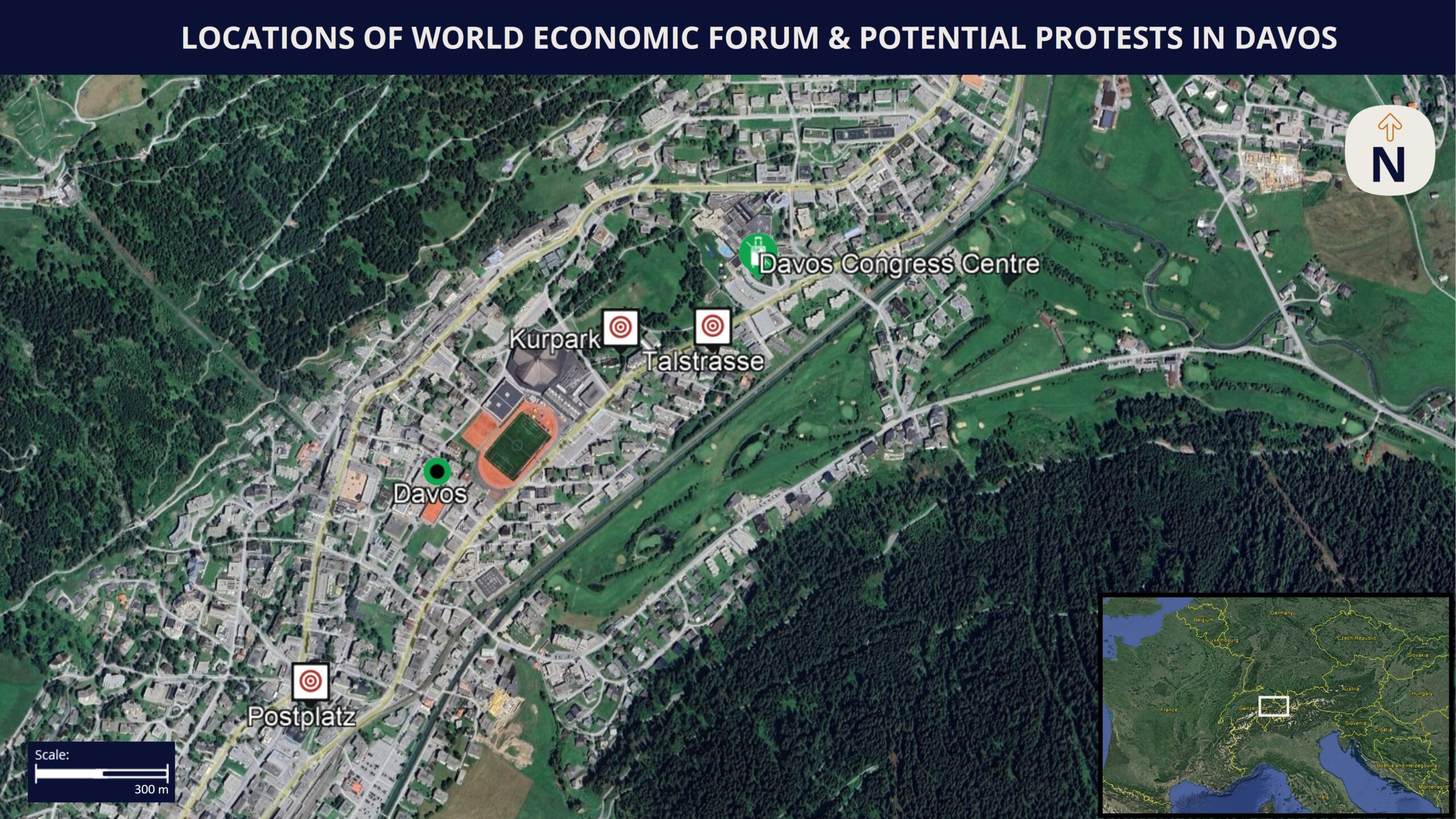
- FORECAST: In addition to planned demonstrations, further protest actions by climate and anti-capitalist groups are likely during the upcoming summit. Climate-focused actions will likely attract participation in the low dozens, while anti-capitalist rallies are likely to draw turnouts in the low hundreds. Within Davos, likely protest locations include Postplatz, the Congress Centre, Promenade, Talstrasse, Kurpark, nearby heliports, airports, and hotels hosting summit delegations.
- FORECAST: The tactics employed during mass-mobilization rallies are likely to include gatherings in central locations, the display of banners, chanting of slogans, and speeches, causing localized travel disruptions in the immediate vicinity. Meanwhile, climate-focused groups are likely to favor high-visibility tactics designed to generate media attention. Expected tactics include brief access blockades at heliports or hotel entrances, banner drops inside or near conference venues, sit-ins at transport nodes, use of placards or inflatable props, and spray-paint vandalism targeting event-related infrastructure. Likely targets include summit venues, hotels hosting high-profile delegates, aviation-related infrastructure linked to private jet travel, and high-traffic pedestrian areas. Such actions are expected to be quickly contained by security forces, though temporary access restrictions, localized delays, and heightened police activity are likely around affected locations.
- Disruptive protest activity remains the primary security threat during WEF due to its symbolic value as a gathering of high-profile political and business officials and the high level of international media attention it attracts, despite the establishment of extensive restricted zones in Davos. Based on precedent from previous WEF summits, such actions are likely to remain largely peaceful; however, the risk of localized disruption, particularly to traffic and access routes, remains elevated.
- During WEF 2025, the far-left political group Jungsozialist*innen Schweiz (JUSO) and the Strike WEF collective held a police-approved rally at Postplatz in Davos on January 19, which dispersed without incident. Meanwhile, during WEF 2023, several hundred demonstrators from JUSO and Strike WEF gathered in Davos on January 15 under the slogan “Tax the Rich, Save the Climate,” temporarily blocking roads and concluding a multi-day winter march featuring banners and chants.
- In addition to mass mobilizations, there is an elevated risk of small-scale but disruptive targeted actions by climate activists at conference venues and nearby travel nodes, such as heliports, airports, railway stations, key road access points, and other transport hubs linked to summit logistics. This is evidenced by Greenpeace International’s actions during WEF 2025, when police removed 10 activists blocking vehicles at the Lago heliport on January 20 while displaying “Tax The Super Rich” banners. On January 21, Greenpeace activists also entered the WEF Congress Centre, climbed a lobby balcony, and unfurled a banner before being removed by security. Separately, during the same summit period, Greenpeace activists symbolically targeted aviation-linked infrastructure by attaching inflatable ball-and-chains to three private jets at Samedan Airport (SMV) near Davos and later sprayed green paint on the temporary base of a multinational e-commerce company in Davos.
- FORECAST: In addition to planned demonstrations, further protest actions by climate and anti-capitalist groups are likely during the upcoming summit. Climate-focused actions will likely attract participation in the low dozens, while anti-capitalist rallies are likely to draw turnouts in the low hundreds. Within Davos, likely protest locations include Postplatz, the Congress Centre, Promenade, Talstrasse, Kurpark, nearby heliports, airports, and hotels hosting summit delegations.
- FORECAST: The tactics employed during mass-mobilization rallies are likely to include gatherings in central locations, the display of banners, chanting of slogans, and speeches, causing localized travel disruptions in the immediate vicinity. Meanwhile, climate-focused groups are likely to favor high-visibility tactics designed to generate media attention. Expected tactics include brief access blockades at heliports or hotel entrances, banner drops inside or near conference venues, sit-ins at transport nodes, use of placards or inflatable props, and spray-paint vandalism targeting event-related infrastructure. Likely targets include summit venues, hotels hosting high-profile delegates, aviation-related infrastructure linked to private jet travel, and high-traffic pedestrian areas. Such actions are expected to be quickly contained by security forces, though temporary access restrictions, localized delays, and heightened police activity are likely around affected locations.
Associated protests in Bern, Zurich, Geneva carry elevated risk of unrest, including clashes with police, vandalism of nearby property
- Meanwhile, protest actions in Swiss cities outside Davos, particularly Bern, Zurich, and Geneva, are assessed to carry a comparatively elevated risk of unrest, including clashes with police and property damage. Unlike Davos, these cities do not have extensive access restrictions, large-scale security deployments, or tightly controlled protest zones during the WEF event, allowing larger crowds to gather more freely. Combined with the presence of active far-left groups, this increases the likelihood of disruption and escalation.
- This is supported by recent precedent. In Bern, several hundred protesters linked to far-left groups, including Berns Revolutionare Jugend and Nowef Winterquartier, gathered at Bahnhofplatz on January 18, 2025, under the “Smash WEF” slogan, during which graffiti was sprayed on public property before police dispersed the crowd. Similarly, in Zurich on January 13, 2024, approximately 200 protesters engaged in symbolic arson, spray-painted a bus, and damaged shopfronts in the city centre.
- FORECAST: As such, upcoming demonstrations in Bern, Zurich, and Geneva are likely to occur at central squares and transport hubs, particularly near train stations, with turnouts in the low-to-mid hundreds. While widespread unrest remains unlikely, the risk of vandalism, brief clashes with police, and enforcement-led dispersals remains elevated.
- Meanwhile, protest actions in Swiss cities outside Davos, particularly Bern, Zurich, and Geneva, are assessed to carry a comparatively elevated risk of unrest, including clashes with police and property damage. Unlike Davos, these cities do not have extensive access restrictions, large-scale security deployments, or tightly controlled protest zones during the WEF event, allowing larger crowds to gather more freely. Combined with the presence of active far-left groups, this increases the likelihood of disruption and escalation.
- This is supported by recent precedent. In Bern, several hundred protesters linked to far-left groups, including Berns Revolutionare Jugend and Nowef Winterquartier, gathered at Bahnhofplatz on January 18, 2025, under the “Smash WEF” slogan, during which graffiti was sprayed on public property before police dispersed the crowd. Similarly, in Zurich on January 13, 2024, approximately 200 protesters engaged in symbolic arson, spray-painted a bus, and damaged shopfronts in the city centre.
- FORECAST: As such, upcoming demonstrations in Bern, Zurich, and Geneva are likely to occur at central squares and transport hubs, particularly near train stations, with turnouts in the low-to-mid hundreds. While widespread unrest remains unlikely, the risk of vandalism, brief clashes with police, and enforcement-led dispersals remains elevated.
Threat of cyberattacks targeting public and private infrastructure during WEF remains elevated, though direct risk to event’s systems remains relatively low
- While the WEF is a high-profile event due to the presence of heads of state, senior officials, and major companies, cyber-attacks pose a higher risk to Swiss government bodies, local authorities, financial institutions, and transport services that are linked to the summit, rather than at the WEF’s own systems. Past incidents show that cyber activity around the WEF is focused on visibility and political signaling.
- This is evidenced by the January 2024 distributed denial-of-service (DDoS) attacks carried out by the pro-Russian hacktivist group NoName, which temporarily disrupted access to Swiss Federal Administration websites during the WEF. The attacks were linked to opposition to Ukrainian President Volodymyr Zelensky’s participation in the event, Switzerland’s sanctions on Russia, and its support for Ukraine, indicating that Swiss state infrastructure was targeted as a proxy for political messaging rather than the WEF platform itself.
- Similarly, during WEF 2025, several Swiss municipal websites and banking-related platforms experienced cyber disruptions, highlighting the exposure of local authorities and financial-sector entities with operational or symbolic ties to the summit. In parallel, WEF organizers warned in February 2024 of phishing and impersonation campaigns using fraudulent emails and text messages posing as WEF representatives, confirming that summit branding continues to be leveraged by cyber-actors to target participants and affiliated stakeholders.
- Swiss cyber authorities have repeatedly assessed that major international events such as the WEF attract cyber activity aimed at generating media attention, testing defenses, or conducting opportunistic intelligence collection. FORECAST: Likely actors include pro-Russian hacktivist collectives such as NoName, other ideologically aligned groups, and state-aligned cyber units, as well as pro-Palestinian actors seeking visibility. Expected tactics include DDoS attacks against government and municipal websites, phishing and credential-harvesting campaigns targeting delegates and financial institutions, impersonation scams exploiting WEF branding, and limited attempts to disrupt media or communications platforms.
- FORECAST: Given the heightened alert posture during the WEF and the low threshold for precautionary responses, there remains a credible risk of hoax bomb threats targeting event venues. Switzerland has recorded sporadic cases of such hoaxes through 2025, often aimed at soft targets such as schools and offices. Because these threats are easy to make and can be issued anonymously using digital tools, they originate from a wide range of actors, including opportunistic individuals and cybercriminals seeking to cause disruption, as well as state-linked actors attempting to intimidate or divert security resources. While such hoax threats do not cause physical harm, they are likely to be taken seriously by authorities and could lead to evacuations, security checks, or temporary closures, resulting in short-term disruption.
- While the WEF is a high-profile event due to the presence of heads of state, senior officials, and major companies, cyber-attacks pose a higher risk to Swiss government bodies, local authorities, financial institutions, and transport services that are linked to the summit, rather than at the WEF’s own systems. Past incidents show that cyber activity around the WEF is focused on visibility and political signaling.
- This is evidenced by the January 2024 distributed denial-of-service (DDoS) attacks carried out by the pro-Russian hacktivist group NoName, which temporarily disrupted access to Swiss Federal Administration websites during the WEF. The attacks were linked to opposition to Ukrainian President Volodymyr Zelensky’s participation in the event, Switzerland’s sanctions on Russia, and its support for Ukraine, indicating that Swiss state infrastructure was targeted as a proxy for political messaging rather than the WEF platform itself.
- Similarly, during WEF 2025, several Swiss municipal websites and banking-related platforms experienced cyber disruptions, highlighting the exposure of local authorities and financial-sector entities with operational or symbolic ties to the summit. In parallel, WEF organizers warned in February 2024 of phishing and impersonation campaigns using fraudulent emails and text messages posing as WEF representatives, confirming that summit branding continues to be leveraged by cyber-actors to target participants and affiliated stakeholders.
- Swiss cyber authorities have repeatedly assessed that major international events such as the WEF attract cyber activity aimed at generating media attention, testing defenses, or conducting opportunistic intelligence collection. FORECAST: Likely actors include pro-Russian hacktivist collectives such as NoName, other ideologically aligned groups, and state-aligned cyber units, as well as pro-Palestinian actors seeking visibility. Expected tactics include DDoS attacks against government and municipal websites, phishing and credential-harvesting campaigns targeting delegates and financial institutions, impersonation scams exploiting WEF branding, and limited attempts to disrupt media or communications platforms.
- FORECAST: Given the heightened alert posture during the WEF and the low threshold for precautionary responses, there remains a credible risk of hoax bomb threats targeting event venues. Switzerland has recorded sporadic cases of such hoaxes through 2025, often aimed at soft targets such as schools and offices. Because these threats are easy to make and can be issued anonymously using digital tools, they originate from a wide range of actors, including opportunistic individuals and cybercriminals seeking to cause disruption, as well as state-linked actors attempting to intimidate or divert security resources. While such hoax threats do not cause physical harm, they are likely to be taken seriously by authorities and could lead to evacuations, security checks, or temporary closures, resulting in short-term disruption.
State-backed espionage to pose a credible threat to WEF, while latent risk of sabotage against critical infrastructure persists at the national level
- During the WEF, both the event itself and wider Swiss public and private sector entities remain vulnerable targets of Moscow-backed hybrid threats, including espionage and sabotage, due to the concentration of senior political, economic, and institutional figures. This is evidenced by the August 2019 interception of two Russian nationals holding diplomatic passports, suspected of preparatory intelligence activity linked to the summit.
- This is especially due to continued heightened tensions between Moscow and Western countries since Russia’s invasion of Ukraine in 2022. Moscow is increasingly relying on covert and deniable measures, such as intelligence collection, cyber activity, UAV incursions, and sabotage, to intimidate, signal opposition, gather information, and test security environments in countries perceived as aligned with Ukraine and antagonistic to its interests.
- FORECAST: Espionage is likely to pose a higher and credible threat to the forum rather than physical sabotage. This is likely to take the form of discreet intelligence collection, surveillance of delegates, mapping of personal and professional networks, and quiet probing of security arrangements. Notably, the Swiss Federal Intelligence Service has assessed in its 2025 annual security report that Russia and China pose the most significant espionage threat to the country, due to their strong intelligence presence. Authorities also assess that dozens of individuals linked to Russian intelligence services are currently present in Switzerland.
- FORECAST: The risk of sabotage directly targeting the summit infrastructure remains relatively low due to overall heightened security and surveillance measures throughout Davos, as well as the absence of precedent during past WEF summits. That said, amid overall heightened sabotage risks in countries supporting Ukraine and those deemed “unfriendly” by Moscow, the latent threat of sabotage incidents at the national level remains.
- FORECAST: In this context, critical infrastructure establishments in transport, logistics, energy, and the defense sectors remain potential targets. Likely tactics include arson attacks against infrastructure assets or vehicles, interference with rail or road networks, damage to power or communications equipment, and tampering with fuel or logistics facilities.
- FORECAST: While multiple Western European airports have reported alleged Russia-backed UAV sightings in recent months, some of which have led to temporary flight disruptions, the likelihood of similar UAV activity near Davos remains low due to strict airspace restrictions and enhanced airspace monitoring in place during the WEF. That said, a latent risk of similar sightings at other Swiss airports in the coming weeks remains, with less restrictive controls than the WEF security zone, making them more vulnerable to such disruptions.
- During the WEF, both the event itself and wider Swiss public and private sector entities remain vulnerable targets of Moscow-backed hybrid threats, including espionage and sabotage, due to the concentration of senior political, economic, and institutional figures. This is evidenced by the August 2019 interception of two Russian nationals holding diplomatic passports, suspected of preparatory intelligence activity linked to the summit.
- This is especially due to continued heightened tensions between Moscow and Western countries since Russia’s invasion of Ukraine in 2022. Moscow is increasingly relying on covert and deniable measures, such as intelligence collection, cyber activity, UAV incursions, and sabotage, to intimidate, signal opposition, gather information, and test security environments in countries perceived as aligned with Ukraine and antagonistic to its interests.
- FORECAST: Espionage is likely to pose a higher and credible threat to the forum rather than physical sabotage. This is likely to take the form of discreet intelligence collection, surveillance of delegates, mapping of personal and professional networks, and quiet probing of security arrangements. Notably, the Swiss Federal Intelligence Service has assessed in its 2025 annual security report that Russia and China pose the most significant espionage threat to the country, due to their strong intelligence presence. Authorities also assess that dozens of individuals linked to Russian intelligence services are currently present in Switzerland.
- FORECAST: The risk of sabotage directly targeting the summit infrastructure remains relatively low due to overall heightened security and surveillance measures throughout Davos, as well as the absence of precedent during past WEF summits. That said, amid overall heightened sabotage risks in countries supporting Ukraine and those deemed “unfriendly” by Moscow, the latent threat of sabotage incidents at the national level remains.
- FORECAST: In this context, critical infrastructure establishments in transport, logistics, energy, and the defense sectors remain potential targets. Likely tactics include arson attacks against infrastructure assets or vehicles, interference with rail or road networks, damage to power or communications equipment, and tampering with fuel or logistics facilities.
- FORECAST: While multiple Western European airports have reported alleged Russia-backed UAV sightings in recent months, some of which have led to temporary flight disruptions, the likelihood of similar UAV activity near Davos remains low due to strict airspace restrictions and enhanced airspace monitoring in place during the WEF. That said, a latent risk of similar sightings at other Swiss airports in the coming weeks remains, with less restrictive controls than the WEF security zone, making them more vulnerable to such disruptions.
Recommendations
- Those operating or residing in Davos between January 18–24 are advised to maintain heightened vigilance near restricted zones, protest routes, hotels hosting delegates, transport hubs, and event venues due to planned and potential unplanned protests and associated unrest against the WEF summit.
- Monitor local news, official advisories, and social media for updates on spontaneous or planned demonstrations and unrest.
- Avoid protest locations and spontaneous gatherings showing signs of crowd congestion or potential unrest. If caught near a demonstration, leave the area promptly and follow police instructions.
- Allot for disruptions to road, rail, and air travel due to restricted access zones, security checkpoints, and protest-related blockages. Plan for alternate routes, flexibility in travel itinerary, and extended transit times when moving between venues, hotels, or airports.
- Allot for disruptions to travel due to the heightened security measures implemented in connection with the WEF meeting.
- If a security checkpoint is encountered, act patiently, while cooperating fully with security personnel. Refrain from photographing security personnel or documenting events.
- Ensure that when traveling, you have sufficient means of identification and can evidence, if required, exactly where you are going.
- Immediately report suspicious behavior or objects to local authorities or on-site security personnel.
- Exercise increased cyber awareness, including avoiding clicking on unsolicited emails, verifying WEF-related communications, and refraining from using unsecured Wi-Fi networks due to potential cyber threats.
- Maintain heightened vigilance near anti-WEF protests in Bern, Geneva, Zurich, and other Swiss cities due to the risk of localized unrest, including clashes with police and vandalism, during these rallies.
- For any questions and risk assessments, please contact [email protected]
This report is written by Trisa Ghosh, Senior Intelligence Analyst, and reviewed by Atharv Desai, Associate Director of Intelligence in the Europe Division.
Executive Summary
- The 2026 World Economic Forum (WEF) will take place in Davos from January 19–23, under extensive security measures, including large-scale military and police deployments, restricted zones, airspace controls, and transport checks.
- Largely peaceful but disruptive protests are the primary threat to the forum in Davos, driven by the WEF’s symbolic status and global media attention.
- Small-scale, high-visibility climate activism is likely to continue, including banner drops, brief access blockades, sit-ins, and symbolic actions targeting summit venues.
- Protests in other Swiss cities, particularly Bern, Zurich, and Geneva, carry a higher risk of unrest, including vandalism and brief clashes with police.
- State-backed, as well as opportunistic cyberattacks targeting Swiss public and private sector establishments, pose a significant risk during WEF. However, the threat of attacks against the event’s own systems remains relatively low.
- Beyond cyber threats, state-backed espionage targeting the WEF remains a credible threat. A latent risk of sabotage against critical infrastructure, such as energy, transport, and logistics, also remains at the national level.
- Those operating or residing in Davos and other Swiss cities, mainly Bern, Geneva, and Zurich, between January 18-24 are advised to maintain heightened vigilance due to the risk of anti-WEF protests, elevated cyber threats, and latent risk of sabotage.
Current Situation
- The 2026 World Economic Forum (WEF) will take place at the Davos Congress Centre in Davos in Graubunden Canton from January 19–23. In response, enhanced security measures will be in place across Davos.
- Several left-wing, climate, and anti-capitalist groups have called for protests against the WEF between January 17- 23, both in Davos and in other major Swiss cities like Bern, Geneva, and Zurich.
- The WEF 2026 will host approximately 2,500 official participants, including 200-300 senior political leaders, heads of state and government, ministers, executives of multi-national companies (MNCs), and representatives of international organizations. Attendance will also include personal security details of the high-profile attendees and international media delegations.
Security Measures
- At least 5000 armed forces deployed in the canton of Graubunden will be involved in supporting the canton’s authorities in carrying out security tasks related to the WEF meeting.
- Security zones with restricted access will be established around the venues from 18:00 (local time) on January 18 to 06:00 on January 23. These include hotels near Kirchner Museum Davos, along Baslerstrasse, and in parts of Promenade and Talstrasse near Kurpark, as well as areas near Davosersee Parkplatz and Eisstadion Davos.
- These zones will be demarcated with traffic barriers, and those entering these zones will be subjected to security checks. Further details can be found here. Checks will also be carried out on roads and trains leading into Davos.
- Due to the security zones, parts of the Promenade and Talstrasse will be closed to the public from January 18 to January 23. Details of which can be found here and here.
- Air traffic will be restricted within a 47-kilometer radius over Davos, as well as near the Swiss borders with Austria and Italy, from January 16 to 24. Additionally, the use of model aircraft, UAVs, and tethered balloons will be restricted in the area between Davos Monstein and Landquart, and in the Chur area from January 14 to 24. Details are available here and here.
Anti-WEF Activism
- Alongside these measures, multiple left-wing, climate, and anti-capitalist groups have announced protests against the WEF between January 17-23.
- In Davos, the Strike WEF group has called for a protest hike from Kublis to Klosters on January 17, with plans to continue towards Davos on January 18 for a rally. The exact rally location in Davos has not yet been announced and is likely to depend on police-approved protest zones and access permissions. Details on the route and timings of the protest action have not been announced and can be checked here.
- Organizers state that the protest targets the WEF as an exclusive and undemocratic platform dominated by political and corporate elites. They argue that access to the Forum is limited; decision-making lacks transparency, and public commitments on social and environmental responsibility are largely superficial.
- Further anti-WEF protests are planned in other cities. In Bern, a demonstration is scheduled to take place at Bahnhofsplatz from 15:00 on January 17. In Zurich, another protest is planned at Burkliplatz from 18:30 on January 19. These actions oppose the WEF’s perceived role in shaping economic and political policies, including those linked to arms exports and capitalist systems, and are also framed as acts of solidarity with populations affected by conflict and state violence, including Palestinians.
- In addition to street protests, several conferences critical of the WEF are scheduled across Switzerland. In Zurich, the event titled “The Other Davos” will be held at the Volkshaus concert hall on January 16 and January 17, presenting itself as an alternative forum addressing global social and economic challenges such as inequality, militarization, climate change, and international solidarity.
- In Geneva, two anti-WEF conferences will take place at Rue Voltaire 24 from 18:30 on January 9 and Rue du Velodrome 18 from 15:00 on January 10. Organizers describe these events as part of broader mobilizations against the WEF, aimed at discussing economic inequality, the concentration of political and corporate power, and the impact of elite decision-making on global affairs, while promoting alternative perspectives on governance and social justice.
Assessments & Forecast
Threat of peaceful, yet disruptive protest actions by climate and anti-capitalist groups to persist during WEF summit in Davos
- Disruptive protest activity remains the primary security threat during WEF due to its symbolic value as a gathering of high-profile political and business officials and the high level of international media attention it attracts, despite the establishment of extensive restricted zones in Davos. Based on precedent from previous WEF summits, such actions are likely to remain largely peaceful; however, the risk of localized disruption, particularly to traffic and access routes, remains elevated.
- During WEF 2025, the far-left political group Jungsozialist*innen Schweiz (JUSO) and the Strike WEF collective held a police-approved rally at Postplatz in Davos on January 19, which dispersed without incident. Meanwhile, during WEF 2023, several hundred demonstrators from JUSO and Strike WEF gathered in Davos on January 15 under the slogan “Tax the Rich, Save the Climate,” temporarily blocking roads and concluding a multi-day winter march featuring banners and chants.
- In addition to mass mobilizations, there is an elevated risk of small-scale but disruptive targeted actions by climate activists at conference venues and nearby travel nodes, such as heliports, airports, railway stations, key road access points, and other transport hubs linked to summit logistics. This is evidenced by Greenpeace International’s actions during WEF 2025, when police removed 10 activists blocking vehicles at the Lago heliport on January 20 while displaying “Tax The Super Rich” banners. On January 21, Greenpeace activists also entered the WEF Congress Centre, climbed a lobby balcony, and unfurled a banner before being removed by security. Separately, during the same summit period, Greenpeace activists symbolically targeted aviation-linked infrastructure by attaching inflatable ball-and-chains to three private jets at Samedan Airport (SMV) near Davos and later sprayed green paint on the temporary base of a multinational e-commerce company in Davos.
- FORECAST: In addition to planned demonstrations, further protest actions by climate and anti-capitalist groups are likely during the upcoming summit. Climate-focused actions will likely attract participation in the low dozens, while anti-capitalist rallies are likely to draw turnouts in the low hundreds. Within Davos, likely protest locations include Postplatz, the Congress Centre, Promenade, Talstrasse, Kurpark, nearby heliports, airports, and hotels hosting summit delegations.
- FORECAST: The tactics employed during mass-mobilization rallies are likely to include gatherings in central locations, the display of banners, chanting of slogans, and speeches, causing localized travel disruptions in the immediate vicinity. Meanwhile, climate-focused groups are likely to favor high-visibility tactics designed to generate media attention. Expected tactics include brief access blockades at heliports or hotel entrances, banner drops inside or near conference venues, sit-ins at transport nodes, use of placards or inflatable props, and spray-paint vandalism targeting event-related infrastructure. Likely targets include summit venues, hotels hosting high-profile delegates, aviation-related infrastructure linked to private jet travel, and high-traffic pedestrian areas. Such actions are expected to be quickly contained by security forces, though temporary access restrictions, localized delays, and heightened police activity are likely around affected locations.
- Disruptive protest activity remains the primary security threat during WEF due to its symbolic value as a gathering of high-profile political and business officials and the high level of international media attention it attracts, despite the establishment of extensive restricted zones in Davos. Based on precedent from previous WEF summits, such actions are likely to remain largely peaceful; however, the risk of localized disruption, particularly to traffic and access routes, remains elevated.
- During WEF 2025, the far-left political group Jungsozialist*innen Schweiz (JUSO) and the Strike WEF collective held a police-approved rally at Postplatz in Davos on January 19, which dispersed without incident. Meanwhile, during WEF 2023, several hundred demonstrators from JUSO and Strike WEF gathered in Davos on January 15 under the slogan “Tax the Rich, Save the Climate,” temporarily blocking roads and concluding a multi-day winter march featuring banners and chants.
- In addition to mass mobilizations, there is an elevated risk of small-scale but disruptive targeted actions by climate activists at conference venues and nearby travel nodes, such as heliports, airports, railway stations, key road access points, and other transport hubs linked to summit logistics. This is evidenced by Greenpeace International’s actions during WEF 2025, when police removed 10 activists blocking vehicles at the Lago heliport on January 20 while displaying “Tax The Super Rich” banners. On January 21, Greenpeace activists also entered the WEF Congress Centre, climbed a lobby balcony, and unfurled a banner before being removed by security. Separately, during the same summit period, Greenpeace activists symbolically targeted aviation-linked infrastructure by attaching inflatable ball-and-chains to three private jets at Samedan Airport (SMV) near Davos and later sprayed green paint on the temporary base of a multinational e-commerce company in Davos.
- FORECAST: In addition to planned demonstrations, further protest actions by climate and anti-capitalist groups are likely during the upcoming summit. Climate-focused actions will likely attract participation in the low dozens, while anti-capitalist rallies are likely to draw turnouts in the low hundreds. Within Davos, likely protest locations include Postplatz, the Congress Centre, Promenade, Talstrasse, Kurpark, nearby heliports, airports, and hotels hosting summit delegations.
- FORECAST: The tactics employed during mass-mobilization rallies are likely to include gatherings in central locations, the display of banners, chanting of slogans, and speeches, causing localized travel disruptions in the immediate vicinity. Meanwhile, climate-focused groups are likely to favor high-visibility tactics designed to generate media attention. Expected tactics include brief access blockades at heliports or hotel entrances, banner drops inside or near conference venues, sit-ins at transport nodes, use of placards or inflatable props, and spray-paint vandalism targeting event-related infrastructure. Likely targets include summit venues, hotels hosting high-profile delegates, aviation-related infrastructure linked to private jet travel, and high-traffic pedestrian areas. Such actions are expected to be quickly contained by security forces, though temporary access restrictions, localized delays, and heightened police activity are likely around affected locations.
Associated protests in Bern, Zurich, Geneva carry elevated risk of unrest, including clashes with police, vandalism of nearby property
- Meanwhile, protest actions in Swiss cities outside Davos, particularly Bern, Zurich, and Geneva, are assessed to carry a comparatively elevated risk of unrest, including clashes with police and property damage. Unlike Davos, these cities do not have extensive access restrictions, large-scale security deployments, or tightly controlled protest zones during the WEF event, allowing larger crowds to gather more freely. Combined with the presence of active far-left groups, this increases the likelihood of disruption and escalation.
- This is supported by recent precedent. In Bern, several hundred protesters linked to far-left groups, including Berns Revolutionare Jugend and Nowef Winterquartier, gathered at Bahnhofplatz on January 18, 2025, under the “Smash WEF” slogan, during which graffiti was sprayed on public property before police dispersed the crowd. Similarly, in Zurich on January 13, 2024, approximately 200 protesters engaged in symbolic arson, spray-painted a bus, and damaged shopfronts in the city centre.
- FORECAST: As such, upcoming demonstrations in Bern, Zurich, and Geneva are likely to occur at central squares and transport hubs, particularly near train stations, with turnouts in the low-to-mid hundreds. While widespread unrest remains unlikely, the risk of vandalism, brief clashes with police, and enforcement-led dispersals remains elevated.
- Meanwhile, protest actions in Swiss cities outside Davos, particularly Bern, Zurich, and Geneva, are assessed to carry a comparatively elevated risk of unrest, including clashes with police and property damage. Unlike Davos, these cities do not have extensive access restrictions, large-scale security deployments, or tightly controlled protest zones during the WEF event, allowing larger crowds to gather more freely. Combined with the presence of active far-left groups, this increases the likelihood of disruption and escalation.
- This is supported by recent precedent. In Bern, several hundred protesters linked to far-left groups, including Berns Revolutionare Jugend and Nowef Winterquartier, gathered at Bahnhofplatz on January 18, 2025, under the “Smash WEF” slogan, during which graffiti was sprayed on public property before police dispersed the crowd. Similarly, in Zurich on January 13, 2024, approximately 200 protesters engaged in symbolic arson, spray-painted a bus, and damaged shopfronts in the city centre.
- FORECAST: As such, upcoming demonstrations in Bern, Zurich, and Geneva are likely to occur at central squares and transport hubs, particularly near train stations, with turnouts in the low-to-mid hundreds. While widespread unrest remains unlikely, the risk of vandalism, brief clashes with police, and enforcement-led dispersals remains elevated.
Threat of cyberattacks targeting public and private infrastructure during WEF remains elevated, though direct risk to event’s systems remains relatively low
- While the WEF is a high-profile event due to the presence of heads of state, senior officials, and major companies, cyber-attacks pose a higher risk to Swiss government bodies, local authorities, financial institutions, and transport services that are linked to the summit, rather than at the WEF’s own systems. Past incidents show that cyber activity around the WEF is focused on visibility and political signaling.
- This is evidenced by the January 2024 distributed denial-of-service (DDoS) attacks carried out by the pro-Russian hacktivist group NoName, which temporarily disrupted access to Swiss Federal Administration websites during the WEF. The attacks were linked to opposition to Ukrainian President Volodymyr Zelensky’s participation in the event, Switzerland’s sanctions on Russia, and its support for Ukraine, indicating that Swiss state infrastructure was targeted as a proxy for political messaging rather than the WEF platform itself.
- Similarly, during WEF 2025, several Swiss municipal websites and banking-related platforms experienced cyber disruptions, highlighting the exposure of local authorities and financial-sector entities with operational or symbolic ties to the summit. In parallel, WEF organizers warned in February 2024 of phishing and impersonation campaigns using fraudulent emails and text messages posing as WEF representatives, confirming that summit branding continues to be leveraged by cyber-actors to target participants and affiliated stakeholders.
- Swiss cyber authorities have repeatedly assessed that major international events such as the WEF attract cyber activity aimed at generating media attention, testing defenses, or conducting opportunistic intelligence collection. FORECAST: Likely actors include pro-Russian hacktivist collectives such as NoName, other ideologically aligned groups, and state-aligned cyber units, as well as pro-Palestinian actors seeking visibility. Expected tactics include DDoS attacks against government and municipal websites, phishing and credential-harvesting campaigns targeting delegates and financial institutions, impersonation scams exploiting WEF branding, and limited attempts to disrupt media or communications platforms.
- FORECAST: Given the heightened alert posture during the WEF and the low threshold for precautionary responses, there remains a credible risk of hoax bomb threats targeting event venues. Switzerland has recorded sporadic cases of such hoaxes through 2025, often aimed at soft targets such as schools and offices. Because these threats are easy to make and can be issued anonymously using digital tools, they originate from a wide range of actors, including opportunistic individuals and cybercriminals seeking to cause disruption, as well as state-linked actors attempting to intimidate or divert security resources. While such hoax threats do not cause physical harm, they are likely to be taken seriously by authorities and could lead to evacuations, security checks, or temporary closures, resulting in short-term disruption.
- While the WEF is a high-profile event due to the presence of heads of state, senior officials, and major companies, cyber-attacks pose a higher risk to Swiss government bodies, local authorities, financial institutions, and transport services that are linked to the summit, rather than at the WEF’s own systems. Past incidents show that cyber activity around the WEF is focused on visibility and political signaling.
- This is evidenced by the January 2024 distributed denial-of-service (DDoS) attacks carried out by the pro-Russian hacktivist group NoName, which temporarily disrupted access to Swiss Federal Administration websites during the WEF. The attacks were linked to opposition to Ukrainian President Volodymyr Zelensky’s participation in the event, Switzerland’s sanctions on Russia, and its support for Ukraine, indicating that Swiss state infrastructure was targeted as a proxy for political messaging rather than the WEF platform itself.
- Similarly, during WEF 2025, several Swiss municipal websites and banking-related platforms experienced cyber disruptions, highlighting the exposure of local authorities and financial-sector entities with operational or symbolic ties to the summit. In parallel, WEF organizers warned in February 2024 of phishing and impersonation campaigns using fraudulent emails and text messages posing as WEF representatives, confirming that summit branding continues to be leveraged by cyber-actors to target participants and affiliated stakeholders.
- Swiss cyber authorities have repeatedly assessed that major international events such as the WEF attract cyber activity aimed at generating media attention, testing defenses, or conducting opportunistic intelligence collection. FORECAST: Likely actors include pro-Russian hacktivist collectives such as NoName, other ideologically aligned groups, and state-aligned cyber units, as well as pro-Palestinian actors seeking visibility. Expected tactics include DDoS attacks against government and municipal websites, phishing and credential-harvesting campaigns targeting delegates and financial institutions, impersonation scams exploiting WEF branding, and limited attempts to disrupt media or communications platforms.
- FORECAST: Given the heightened alert posture during the WEF and the low threshold for precautionary responses, there remains a credible risk of hoax bomb threats targeting event venues. Switzerland has recorded sporadic cases of such hoaxes through 2025, often aimed at soft targets such as schools and offices. Because these threats are easy to make and can be issued anonymously using digital tools, they originate from a wide range of actors, including opportunistic individuals and cybercriminals seeking to cause disruption, as well as state-linked actors attempting to intimidate or divert security resources. While such hoax threats do not cause physical harm, they are likely to be taken seriously by authorities and could lead to evacuations, security checks, or temporary closures, resulting in short-term disruption.
State-backed espionage to pose a credible threat to WEF, while latent risk of sabotage against critical infrastructure persists at the national level
- During the WEF, both the event itself and wider Swiss public and private sector entities remain vulnerable targets of Moscow-backed hybrid threats, including espionage and sabotage, due to the concentration of senior political, economic, and institutional figures. This is evidenced by the August 2019 interception of two Russian nationals holding diplomatic passports, suspected of preparatory intelligence activity linked to the summit.
- This is especially due to continued heightened tensions between Moscow and Western countries since Russia’s invasion of Ukraine in 2022. Moscow is increasingly relying on covert and deniable measures, such as intelligence collection, cyber activity, UAV incursions, and sabotage, to intimidate, signal opposition, gather information, and test security environments in countries perceived as aligned with Ukraine and antagonistic to its interests.
- FORECAST: Espionage is likely to pose a higher and credible threat to the forum rather than physical sabotage. This is likely to take the form of discreet intelligence collection, surveillance of delegates, mapping of personal and professional networks, and quiet probing of security arrangements. Notably, the Swiss Federal Intelligence Service has assessed in its 2025 annual security report that Russia and China pose the most significant espionage threat to the country, due to their strong intelligence presence. Authorities also assess that dozens of individuals linked to Russian intelligence services are currently present in Switzerland.
- FORECAST: The risk of sabotage directly targeting the summit infrastructure remains relatively low due to overall heightened security and surveillance measures throughout Davos, as well as the absence of precedent during past WEF summits. That said, amid overall heightened sabotage risks in countries supporting Ukraine and those deemed “unfriendly” by Moscow, the latent threat of sabotage incidents at the national level remains.
- FORECAST: In this context, critical infrastructure establishments in transport, logistics, energy, and the defense sectors remain potential targets. Likely tactics include arson attacks against infrastructure assets or vehicles, interference with rail or road networks, damage to power or communications equipment, and tampering with fuel or logistics facilities.
- FORECAST: While multiple Western European airports have reported alleged Russia-backed UAV sightings in recent months, some of which have led to temporary flight disruptions, the likelihood of similar UAV activity near Davos remains low due to strict airspace restrictions and enhanced airspace monitoring in place during the WEF. That said, a latent risk of similar sightings at other Swiss airports in the coming weeks remains, with less restrictive controls than the WEF security zone, making them more vulnerable to such disruptions.
- During the WEF, both the event itself and wider Swiss public and private sector entities remain vulnerable targets of Moscow-backed hybrid threats, including espionage and sabotage, due to the concentration of senior political, economic, and institutional figures. This is evidenced by the August 2019 interception of two Russian nationals holding diplomatic passports, suspected of preparatory intelligence activity linked to the summit.
- This is especially due to continued heightened tensions between Moscow and Western countries since Russia’s invasion of Ukraine in 2022. Moscow is increasingly relying on covert and deniable measures, such as intelligence collection, cyber activity, UAV incursions, and sabotage, to intimidate, signal opposition, gather information, and test security environments in countries perceived as aligned with Ukraine and antagonistic to its interests.
- FORECAST: Espionage is likely to pose a higher and credible threat to the forum rather than physical sabotage. This is likely to take the form of discreet intelligence collection, surveillance of delegates, mapping of personal and professional networks, and quiet probing of security arrangements. Notably, the Swiss Federal Intelligence Service has assessed in its 2025 annual security report that Russia and China pose the most significant espionage threat to the country, due to their strong intelligence presence. Authorities also assess that dozens of individuals linked to Russian intelligence services are currently present in Switzerland.
- FORECAST: The risk of sabotage directly targeting the summit infrastructure remains relatively low due to overall heightened security and surveillance measures throughout Davos, as well as the absence of precedent during past WEF summits. That said, amid overall heightened sabotage risks in countries supporting Ukraine and those deemed “unfriendly” by Moscow, the latent threat of sabotage incidents at the national level remains.
- FORECAST: In this context, critical infrastructure establishments in transport, logistics, energy, and the defense sectors remain potential targets. Likely tactics include arson attacks against infrastructure assets or vehicles, interference with rail or road networks, damage to power or communications equipment, and tampering with fuel or logistics facilities.
- FORECAST: While multiple Western European airports have reported alleged Russia-backed UAV sightings in recent months, some of which have led to temporary flight disruptions, the likelihood of similar UAV activity near Davos remains low due to strict airspace restrictions and enhanced airspace monitoring in place during the WEF. That said, a latent risk of similar sightings at other Swiss airports in the coming weeks remains, with less restrictive controls than the WEF security zone, making them more vulnerable to such disruptions.
Recommendations
- Those operating or residing in Davos between January 18–24 are advised to maintain heightened vigilance near restricted zones, protest routes, hotels hosting delegates, transport hubs, and event venues due to planned and potential unplanned protests and associated unrest against the WEF summit.
- Monitor local news, official advisories, and social media for updates on spontaneous or planned demonstrations and unrest.
- Avoid protest locations and spontaneous gatherings showing signs of crowd congestion or potential unrest. If caught near a demonstration, leave the area promptly and follow police instructions.
- Allot for disruptions to road, rail, and air travel due to restricted access zones, security checkpoints, and protest-related blockages. Plan for alternate routes, flexibility in travel itinerary, and extended transit times when moving between venues, hotels, or airports.
- Allot for disruptions to travel due to the heightened security measures implemented in connection with the WEF meeting.
- If a security checkpoint is encountered, act patiently, while cooperating fully with security personnel. Refrain from photographing security personnel or documenting events.
- Ensure that when traveling, you have sufficient means of identification and can evidence, if required, exactly where you are going.
- Immediately report suspicious behavior or objects to local authorities or on-site security personnel.
- Exercise increased cyber awareness, including avoiding clicking on unsolicited emails, verifying WEF-related communications, and refraining from using unsecured Wi-Fi networks due to potential cyber threats.
- Maintain heightened vigilance near anti-WEF protests in Bern, Geneva, Zurich, and other Swiss cities due to the risk of localized unrest, including clashes with police and vandalism, during these rallies.
- For any questions and risk assessments, please contact [email protected]
Related Reports
Switzerland
-
 TravelEurope Analysis: Risk of petty crime, violence, unrest during New Year’s Eve celebratory gatherings remains despite bolstered security measures in multiple cities
 -
TravelGlobal Special Report: Increased risk of violence targeting religious, symbolic events during holiday season
-
 Supply Chain DisruptionsGlobal Special Report: Irregular global cryptocurrency regulations to result in persisting strategic risks to private companies
 -
 DevelopingEurope Analysis: Russian hybrid warfare operations including low-level UAV incursions will continue to pose elevated threat in Europe, increasing tactical, operational risks for businesses; although risk of direct NATO-Russia confrontation remains low
Related Reports
Switzerland
-
TravelEurope Analysis: Risk of petty crime, violence, unrest during New Year’s Eve celebratory gatherings remains despite bolstered security measures in multiple cities
-
TravelGlobal Special Report: Increased risk of violence targeting religious, symbolic events during holiday season
-
Supply Chain DisruptionsGlobal Special Report: Irregular global cryptocurrency regulations to result in persisting strategic risks to private companies
-
DevelopingEurope Analysis: Russian hybrid warfare operations including low-level UAV incursions will continue to pose elevated threat in Europe, increasing tactical, operational risks for businesses; although risk of direct NATO-Russia confrontation remains low