

10
Dec 2025
16:44 UTC
Syria Alert (UPDATE): Three projectiles land near Damascus’ Mezzeh Military Airport on December 9; likely intended to undermine Liberation Day celebrations
Current Situation:
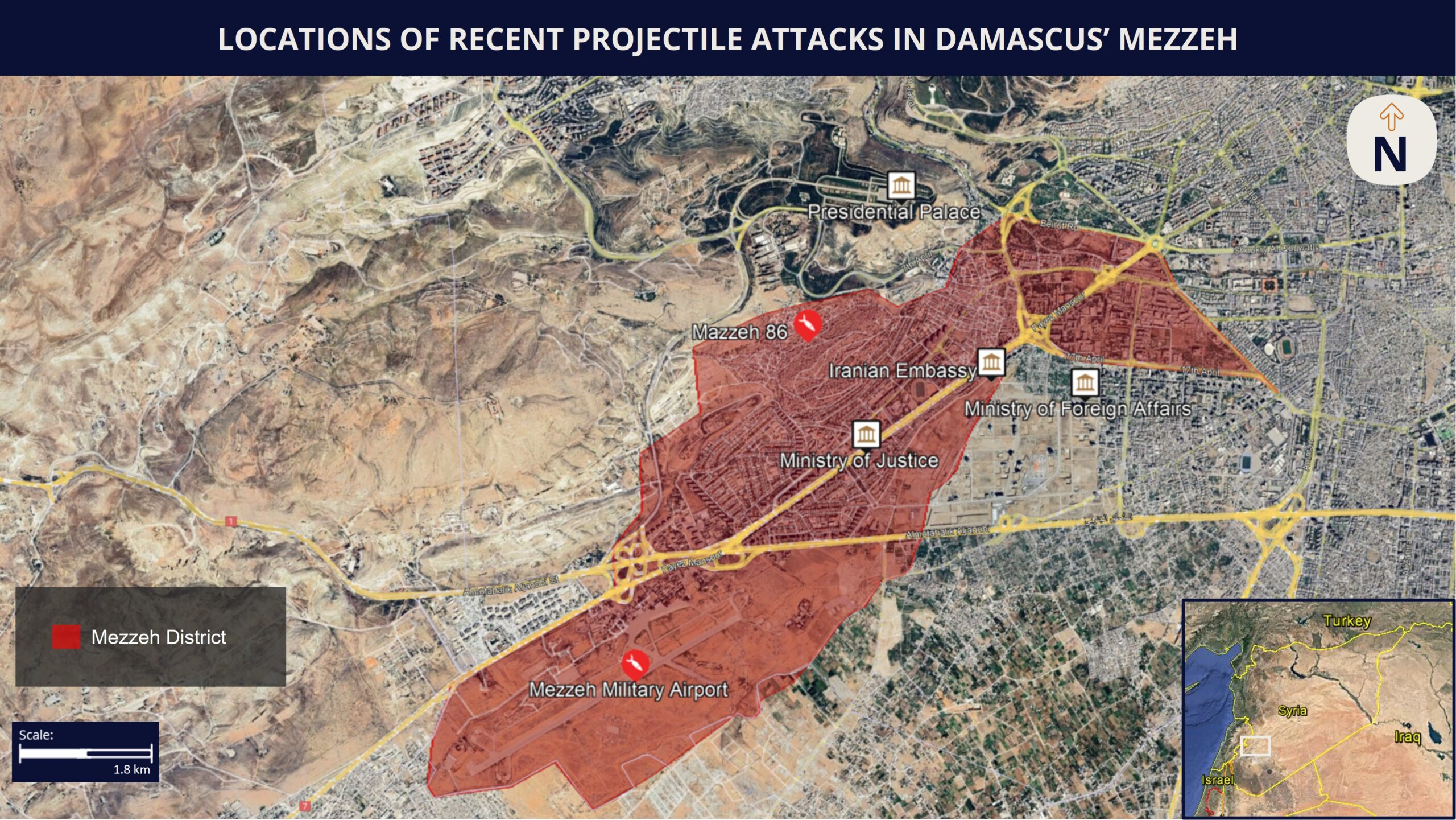
- The Syrian state news agency reported that three projectiles of unknown origin landed in the vicinity of Damascus’ Mezzeh Military Airport on December 9.
- In a subsequent statement, it added that the Internal Security Forces (ISF) discovered four launch platforms used in the attack. The location was not specified.
- No group has claimed responsibility for the attack, which did not result in casualties or damage.
Source: SANA
Assessments & Forecast:
- The apparent attack occurred shortly after the Liberation Day celebrations held across Syria, celebrating the one-year anniversary of former President Bashar al-Assad’s ousting by the Hay’at Tahrir al-Sham (HTS)-led rebel offensive on December 8, 2024. This included a major parade that commenced from the Mezzeh Military Airport one day prior to the incident.
- In this context, it is plausible that this constituted a symbolic attack conducted to disrupt celebrations, undermine President Ahmad al-Sharaa’s administration, and sow a sense of insecurity in the capital. The two most plausible perpetrators are therefore either anti-government/pro-Assad loyalists or jihadist actors such as the Islamic State (IS).
- Loyalists are likely to retain a presence in the high-profile Mezzeh district given its history as a former al-Assad stronghold, potentially enabling such actors to prepare for and launch attacks. This could be facilitated by segments of the predominantly Alawite community in Mezzeh, who may be more inclined to support those affiliated with the former Alawite President al-Assad. This is particularly given significant grievances harbored by the community amid the perceived failure of the Islamist government to adequately protect the sect, resulting in repeated instances of sectarian violence since December 2024.
- This scenario is lent some credence by recent reports that former government officials affiliated with al-Assad are seeking to mobilize Alawite militias in northwestern Syria. It cannot be ruled out that such actors are also encouraging smaller cells to conduct such activity in the new government’s stronghold, Damascus.
- Additionally, a scenario in which jihadist factions conducted the attack is plausible, with the Islamic State (IS) constituting the most likely actor. This is given the group’s widely documented grievances toward President al-Sharaa over his outreach to the West, IS presence in areas near Damascus, and evidence that the group has acquired a range of arms, including projectiles. This is demonstrated by joint US Central Command (CENTCOM) and Syrian government raids in Rif Dimashq on November 30, in which rockets and mortars were among the arms seized at 15 weapons cache sites. Moreover, IS could be specifically motivated to target the Mezzeh Military Airport given its potential for use by the US, which is reportedly preparing to establish a military presence at an airbase in Damascus to facilitate a joint security pact.
- Regardless, the failure to inflict considerable damage or casualties, together with images released by Syrian state media depicting rudimentary launch pads used in the attack, suggests that the perpetrators were not highly trained or capable of conducting a successful, sophisticated attack. However, the incident nonetheless highlights significant gaps in security protocol in the capital. This is particularly given that it comes less than one month after two Katyusha rockets struck a building near the Presidential Palace in Mezzeh’s Mazzeh 86 neighborhood, located less than five km from the latest incident, on November 14-15.
- Together, these developments depict a particular risk in the Mezzeh district, which houses several international embassies and other government-linked sites. This may be partially derived from its location on the outskirts of the capital, which is potentially vulnerable to attacks from outlying areas where security protocols are weaker. FORECAST: In this context, authorities are likely to bolster security measures in Mezzeh and intensify security operations in Damascus and the surrounding areas in the coming weeks.
Recommendations:
- Avoid all travel to Syria at the current juncture due to the volatile security environment, including the elevated risks of militancy and armed conflict.
- Travel to Damascus should be for essential purposes only, while adhering to all security precautions regarding the threat of militant attacks and potential for airstrikes.
- Those conducting essential operations should seek security escorts and a local fixer to facilitate coordination with Syrian government authorities.
- Avoid the vicinity of government and military installations throughout Syria, including in Damascus, as well as the border areas with Israel and Lebanon due to the persistent risk of Israeli strikes.
- Remain cognizant of the extreme risk posed by jihadist militant groups in the country, including the Islamic State (IS).
COUNTRY RISK LEVEL
Extreme
AFFECTED AREA
Mezzeh, Damascus; Syria
INCIDENT RISK LEVEL
High
STRENGTH OF SOURCE
Confirmed
Current Situation:
- The Syrian state news agency reported that three projectiles of unknown origin landed in the vicinity of Damascus’ Mezzeh Military Airport on December 9.
- In a subsequent statement, it added that the Internal Security Forces (ISF) discovered four launch platforms used in the attack. The location was not specified.
- No group has claimed responsibility for the attack, which did not result in casualties or damage.
Source: SANA
Assessments & Forecast:
- The apparent attack occurred shortly after the Liberation Day celebrations held across Syria, celebrating the one-year anniversary of former President Bashar al-Assad’s ousting by the Hay’at Tahrir al-Sham (HTS)-led rebel offensive on December 8, 2024. This included a major parade that commenced from the Mezzeh Military Airport one day prior to the incident.
- In this context, it is plausible that this constituted a symbolic attack conducted to disrupt celebrations, undermine President Ahmad al-Sharaa’s administration, and sow a sense of insecurity in the capital. The two most plausible perpetrators are therefore either anti-government/pro-Assad loyalists or jihadist actors such as the Islamic State (IS).
- Loyalists are likely to retain a presence in the high-profile Mezzeh district given its history as a former al-Assad stronghold, potentially enabling such actors to prepare for and launch attacks. This could be facilitated by segments of the predominantly Alawite community in Mezzeh, who may be more inclined to support those affiliated with the former Alawite President al-Assad. This is particularly given significant grievances harbored by the community amid the perceived failure of the Islamist government to adequately protect the sect, resulting in repeated instances of sectarian violence since December 2024.
- This scenario is lent some credence by recent reports that former government officials affiliated with al-Assad are seeking to mobilize Alawite militias in northwestern Syria. It cannot be ruled out that such actors are also encouraging smaller cells to conduct such activity in the new government’s stronghold, Damascus.
- Additionally, a scenario in which jihadist factions conducted the attack is plausible, with the Islamic State (IS) constituting the most likely actor. This is given the group’s widely documented grievances toward President al-Sharaa over his outreach to the West, IS presence in areas near Damascus, and evidence that the group has acquired a range of arms, including projectiles. This is demonstrated by joint US Central Command (CENTCOM) and Syrian government raids in Rif Dimashq on November 30, in which rockets and mortars were among the arms seized at 15 weapons cache sites. Moreover, IS could be specifically motivated to target the Mezzeh Military Airport given its potential for use by the US, which is reportedly preparing to establish a military presence at an airbase in Damascus to facilitate a joint security pact.
- Regardless, the failure to inflict considerable damage or casualties, together with images released by Syrian state media depicting rudimentary launch pads used in the attack, suggests that the perpetrators were not highly trained or capable of conducting a successful, sophisticated attack. However, the incident nonetheless highlights significant gaps in security protocol in the capital. This is particularly given that it comes less than one month after two Katyusha rockets struck a building near the Presidential Palace in Mezzeh’s Mazzeh 86 neighborhood, located less than five km from the latest incident, on November 14-15.
- Together, these developments depict a particular risk in the Mezzeh district, which houses several international embassies and other government-linked sites. This may be partially derived from its location on the outskirts of the capital, which is potentially vulnerable to attacks from outlying areas where security protocols are weaker. FORECAST: In this context, authorities are likely to bolster security measures in Mezzeh and intensify security operations in Damascus and the surrounding areas in the coming weeks.
Recommendations:
- Avoid all travel to Syria at the current juncture due to the volatile security environment, including the elevated risks of militancy and armed conflict.
- Travel to Damascus should be for essential purposes only, while adhering to all security precautions regarding the threat of militant attacks and potential for airstrikes.
- Those conducting essential operations should seek security escorts and a local fixer to facilitate coordination with Syrian government authorities.
- Avoid the vicinity of government and military installations throughout Syria, including in Damascus, as well as the border areas with Israel and Lebanon due to the persistent risk of Israeli strikes.
- Remain cognizant of the extreme risk posed by jihadist militant groups in the country, including the Islamic State (IS).
COUNTRY RISK LEVEL
Extreme
AFFECTED AREA
Mezzeh, Damascus; Syria
INCIDENT RISK LEVEL
High
STRENGTH OF SOURCE
Confirmed
Related Reports
Syria
-
 DevelopingSyria Alert (UPDATE): Explosion near Four Seasons Hotel in Damascus during afternoon hours of December 7 reportedly caused by sound bomb; continue avoiding all travel to area
 -
 MaritimeGulf of Oman Alert (UPDATE): Iran reportedly releases MV Talara on November 19; continue taking precautions
 -
 MaritimeGulf of Oman Alert (UPDATE): Iranian forces reportedly seize vessel transiting Gulf of Oman on November 14; likely to elevate maritime security concerns
 -
 Armed ConflictIsrael & Palestinian Territories Alert (UPDATE): IDF reaffirms adherence to ceasefire during evening hours of October 19; immediate de-escalation likely
Related Reports
Syria
-
DevelopingSyria Alert (UPDATE): Explosion near Four Seasons Hotel in Damascus during afternoon hours of December 7 reportedly caused by sound bomb; continue avoiding all travel to area
-
MaritimeGulf of Oman Alert (UPDATE): Iran reportedly releases MV Talara on November 19; continue taking precautions
-
MaritimeGulf of Oman Alert (UPDATE): Iranian forces reportedly seize vessel transiting Gulf of Oman on November 14; likely to elevate maritime security concerns
-
Armed ConflictIsrael & Palestinian Territories Alert (UPDATE): IDF reaffirms adherence to ceasefire during evening hours of October 19; immediate de-escalation likely